


Seamlessly connect your indoor and outdoor living spaces with sleek, energy-efficient uPVC Balcony Doors from OKNOPLAST.

Balcony Doors designed for comfort, style and performance
Explore the versatility and security of our balcony and entry door systems, designed to meet diverse needs and preferences. Whether you’re looking for a door that combines window-like functionality, energy efficiency, or enhanced security, OKNOPLAST offers the perfect solutions with the Pixel, PAVA Balcony Door systems. Below are the key features and benefits of each door type, tailored to different spaces and requirements.


Pixel System Balcony Doors
Experience the blend of window functionality with entry-door security.
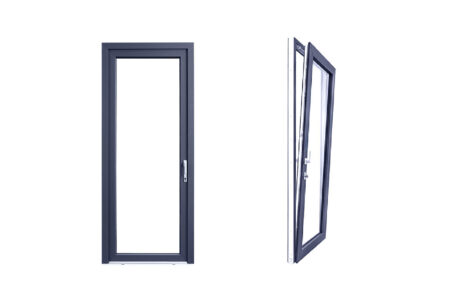
- Tilt and Turn Functionality: offers both tilting and turning options, providing flexibility and ventilation control.
- Dual-Sided Handle with Key Lock: equipped with a key lock on the outside and a thumb-turn on the inside, offering enhanced safety and ease of use.
- Low Threshold and Sash Height: features a low ¾-inch aluminum threshold and a sash height of 4.13 inches, ideal for patio doors that require secure locking and smooth transitions.
- Who It’s For: perfect for those seeking a tilting door option with secure locking for their balcony or patio.
- System Compatibility: available within the PIXEL system.


PAVA System Balcony Doors
Achieve a sleek window-like look with integrated insect protection and accessibility.
- Tilt and Turn Functionality: provides easy ventilation and accessibility with its tilting and turning capabilities.
- ADA-Compliant Low Threshold: boasts a ¼-inch threshold, making it ADA-compliant and suitable for spaces where ease of access is a priority.
- Interior Handle Only: features an internal handle without a key lock, ideal for spaces where security locks aren’t necessary. The WinClick latch allows for simple closing from the outside.
- Energy Efficiency: comes with triple glazing for superior energy efficiency and a sash height of 2.75 inches.
- Who It’s For: perfect for balconies or terraces, prioritizing ease of access, energy efficiency, and insect protection without the need for a key lock.
- System Compatibility: available within the PAVA system.


Avalaible thresholds



Let’s talk about your project!
Request a quote, discuss specifications, or get help choosing the right system
Send a request
"*" indicates required fields
Balcony Doors with glass
OKNOPLAST balcony doors are inward-swinging Tilt and Turn door systems manufactured in Poland, available in uPVC configurations – PAVA (U-Factor 0.14-0.26 BTU/hr·ft²·°F, DP-80) and PIXEL (U-Factor 0.16-0.29 BTU/hr·ft²·°F, DP-80) – and the MIRU EVO HIDDEN aluminum system (maximum sash height 8’8″, maximum sash width 4’1″, opening sash invisible from the exterior, balcony doors explicitly supported). All systems are NFRC-certified and carry a 10-year product guarantee. A dedicated balcony latch – available in 8 finishes – allows closing the sash from the balcony side without re-entering the unit. Lead time to U.S. delivery is 8-10 weeks from confirmed order.
What Are Balcony Doors and How Do They Differ from Patio Doors and French Doors?
A balcony door is a door-height Tilt and Turn unit – floor-to-ceiling or near-floor-to-ceiling in height, typically 7′-9′ tall and one sash wide – that provides access to a balcony, terrace, or loggia while operating on the same two-position inward-swing mechanism as a Tilt and Turn window, delivering both controlled-tilt ventilation and full inward-swing egress in a single leaf. This operational definition distinguishes the balcony door from both the American patio door and the French door in ways that matter for multi-story residential and commercial specification. A standard sliding patio door opens parallel to the wall – the sash slides on a bottom track rather than swinging inward. This mechanism is practical for ground-floor patio access where floor space adjacent to the opening is unconstrained, but it produces an asymmetrical opening (typically 50-60% of frame width) that does not meet IRC Section R310 emergency escape and rescue opening requirements as a primary egress path without supplementary egress windows. A Tilt and Turn balcony door, in full-swing (turn) position, opens 100% of the sash width – meeting IRC R310’s minimum 20″ net clear opening width for emergency escape – while occupying no floor space in the sliding range. A French door (a pair of outward-swinging hinged panels) serves a similar egress function but swings outward – onto the balcony deck. On upper-floor balconies where the exterior slab is immediately adjacent to the door opening, outward swing conflicts with balustrade placement and building code requirements for guardrail clearance from the outward door swing arc. Tilt and Turn balcony doors swing inward only, eliminating exterior balcony conflicts entirely. The OKNOPLAST balcony door in uPVC (PAVA, PIXEL) and aluminum (MIRU EVO HIDDEN) combines these egress and ventilation functions with NFRC-certified thermal performance – U-Factor as low as 0.14 BTU/hr·ft²·°F in PAVA triple-pane configuration – making it the applicable specification for residential and multifamily projects where the building envelope performance target, the egress path, and the exterior facade appearance must be simultaneously addressed.
PAVA and PIXEL uPVC Balcony Doors: Tilt and Turn, DP-80, U-Factor 0.14-0.29
OKNOPLAST uPVC balcony doors using the PAVA system achieve U-Factor 0.14-0.26 BTU/hr·ft²·°F (NFRC-certified), Design Pressure DP-80, STC 32-46 / OITC 26-37 acoustic rating, and maximum sash height of 102½” with maximum sash width of 56″ – using the same 82 mm / 3¼” 7-chamber steel-reinforced frame as the PAVA window range, configured at door height with floor-level threshold or low-threshold installation. The PIXEL system delivers U-Factor 0.16-0.29 BTU/hr·ft²·°F (NFRC-certified), DP-80, STC 32-46 / OITC 26-39, and the same 102½” × 56″ maximum sash dimensions in a 70 mm / 2¾” 6-chamber frame with bent-steel reinforcement. Both systems operate as Tilt and Turn doors – the same single-handle dual-position mechanism as PAVA and PIXEL windows, scaled to door height. In the tilt position, the door sash opens 4-6 inches at the top, delivering controlled balcony ventilation without full-swing inward clearance. In the turn (full-swing) position, the sash rotates inward on a vertical axis, providing full-width clear opening for egress, cleaning, or furniture delivery. Multi-point locking at 3-5 perimeter compression points produces air infiltration below 0.10 CFM/ft² at 25 Pa (ASTM E283) – a performance level that standard hinged doors with single-point latches and standard sliding patio doors cannot routinely achieve. PAVA in triple-pane configuration with PHIUS Passive House recommendation is the applicable specification when the project targets the lower end of the U-Factor range – Climate Zones 5-8, PHIUS 2021+ passive house certification, or near-passive residential construction where the balcony door is the primary thermal vulnerability in the building envelope because of its floor-to-ceiling glazing area. PAVA Light (double-pane, U-Factor from 0.25) is the specification for moderate and warm climate regions (Zones 1-5) where the lighter sash is an advantage in wood-frame and light-gauge steel construction. PIXEL uPVC balcony doors carry ADA Standards compliance and deliver the narrowest movable mullion in the uPVC range – 33% narrower than equivalent structural-grade profiles – for projects where slim-profile aesthetics at door height are a design requirement.
MIRU EVO HIDDEN Aluminum Balcony Door: Concealed Sash, Max 8’8″, Consistent Facade Appearance
The MIRU EVO HIDDEN is an aluminum Tilt and Turn window and balcony door system with maximum sash height of 8’8″ (at sash widths up to 3’8″) and maximum sash width of 4’1″ (at sash heights up to 7’10”) – in a 2 15/16″ frame installation depth with 3 5/16″ frame and sash depth – specifically supporting balcony door configurations in which the opening sash is invisible from the exterior, maintaining a consistent fixed-glazing appearance from all sides of the building facade. The concealed sash technology of the MIRU EVO HIDDEN places the operating hardware, hinge mechanism, and sash frame perimeter behind a flush aluminum frame face – eliminating the visible sash line that distinguishes operable from fixed glazing in conventional aluminum window and door frames. On a multi-story residential or hospitality facade where some units have operable balcony doors and others have fixed glazing panels at the same dimension, the HIDDEN system makes both indistinguishable from the exterior. This facade consistency is a specification requirement on projects where the architectural intent – documented in building specifications and AHJ submissions – requires visual uniformity across the curtainwall or window wall grid. The MIRU EVO HIDDEN balcony door is compatible with the MIRU EVO STANDARD window system, allowing mixed installations on the same facade: HIDDEN balcony doors at floor-to-ceiling height and STANDARD windows in the same aluminum frame system above or adjacent, with a matching 2 15/16″ frame installation depth providing a flush, continuous aluminum sight line across the full building elevation. The HIDDEN system does not carry the same maximum sash dimensions as the STANDARD (which reaches 10’2″ height and 5’3″ width) – the 8’8″ × 4’1″ envelope reflects the structural constraints of the concealment mechanism and is consistent with standard residential balcony door proportions in mid-rise construction (one sash wide, story height). IFT Quality Mark certification (ID 190-6038531-8) and CEKAL IGU certification apply to the MIRU EVO HIDDEN system. 10-year product guarantee.
What Is a Balcony Latch and When Is It Required?
A balcony latch is the hardware component – available in 8 finish options for MIRU EVO STANDARD-compatible systems – that allows closing the Tilt and Turn balcony door sash from the exterior balcony side, a function the interior-facing handle mechanism cannot provide after the occupant steps outside and the sash swings inward behind them. The operational sequence requiring a balcony latch is specific to upper-floor balconies: the occupant opens the door inward, steps outside, and wishes to close the door to prevent interior heat or cooling loss, rain ingress, or child safety risk while remaining on the balcony. A single-button or lever latch mounted in the exterior sash face – accessible from the balcony side – closes the sash against the frame seal and holds it in the latched position. The multi-point locking system must be engaged from the interior handle to fully lock the door; the balcony latch provides the weather seal and temporary security closure only. OKNOPLAST’s balcony latch is available for the MIRU EVO STANDARD aluminum system in 8 finish options matching the standard OKNOPLAST hardware palette: gold F4, graphite F9, silver F1, silver stainless steel, anthracite RAL 7016, brown RAL 8019, black RAL 9005, and white RAL 9016. The latch handle is manufactured from aluminum. Specify the balcony latch on any MIRU EVO HIDDEN or MIRU EVO STANDARD balcony door application where occupants will access the exterior balcony and close the door from outside. For uPVC PAVA and PIXEL balcony doors, confirm balcony latch availability and specification details with your authorized OKNOPLAST dealer for the specific configuration.
How Does Tilt and Turn Operation Address Balcony Egress Requirements?
Tilt and Turn balcony doors in the full-swing (turn) position provide a minimum net clear opening equal to the full sash width – typically 24″-48″ in residential balcony door configurations – meeting the IRC Section R310.1 emergency escape and rescue opening requirement of 20″ minimum net clear opening width and 24″ minimum net clear opening height, as the sash swings fully inward on a vertical axis without a horizontal sliding track obstructing the opening plane. IRC Section R310 governs emergency escape and rescue openings (EEROs) in residential sleeping rooms and basements in buildings regulated under the IRC. Balcony doors accessing exterior balconies in direct line with sleeping room egress paths are relevant to R310 compliance where the door serves as the primary or supplementary egress point. The 2021 IRC requires a minimum opening area of 5.7 ft², minimum net clear opening height of 24″, and minimum net clear opening width of 20″ at a maximum sill height of 44″ above the floor. A standard Tilt and Turn balcony door sash at 32″-48″ width and 80″-100″ height exceeds these minimums by a substantial margin in the full-swing turn position. A standard sliding patio door provides only the width of the moving panel – typically 50-60% of the total frame width – as the net clear opening, with the track at the threshold creating an obstacle at the sill. A single-track sliding patio door in a 6’0″ frame provides approximately 35″ net clear width, marginally meeting R310; a multi-panel sliding configuration with staggered sashes may provide less. The Tilt and Turn mechanism in balcony door configuration provides 100% of sash width as net clear opening and a flat threshold plane, making R310 compliance unambiguous from the unit specification. Passive House and high-performance residential designers in Climate Zones 4-7 consistently specify Tilt and Turn balcony doors over hinged French doors and sliding patio doors for this reason: the same unit that delivers sub-0.10 CFM/ft² air infiltration and U-Factor 0.14-0.26 (PAVA triple-pane) also meets IRC R310 egress criteria in the same operating position – without requiring a separate operable window above a patio door for egress compliance.
Wind Load at Elevation: DP Ratings for Balcony Doors on Upper Floors
PAVA and PIXEL uPVC balcony doors carry Design Pressure DP-80 – the same rating as the equivalent window configurations – which is the applicable structural specification for balcony doors at floors 1 through approximately 6-8 in standard Exposure Category B terrain per ASCE 7-22 (urban and suburban areas, wooded areas), and for floors 1 through approximately 3-4 in Exposure Category C (open terrain with scattered obstructions, including flat open country and grasslands) depending on project location and basic wind speed per ASCE 7-22 Figure 26.5-1A. ASCE 7-22 wind pressure on fenestration increases with height above grade, with the velocity pressure exposure coefficient (Kz) increasing from 0.57 at 0-15 ft to approximately 0.76 at 40 ft and 0.85 at 60 ft above grade in Exposure B per ASCE 7-22 Table 26.10-1. At a basic wind speed of 110 mph (applicable to most of the Northeast, Mid-Atlantic, and Mid-Continent U.S.), the design pressure on a component and cladding fenestration element at the 40 ft level (approximately floor 4-5) in Exposure B reaches approximately 45-55 psf depending on tributary area and zone location – within DP-80 capacity. In coastal Exposure C environments with basic wind speeds of 130-140 mph, the same floor range may produce design pressures approaching 60-70 psf, still within DP-80 but requiring verification with the project structural engineer for the specific installation. For multifamily mid-rise projects in Climate Zones 4-6 using OKNOPLAST balcony doors on individual unit balconies, confirm the Design Pressure requirement with the project structural engineer using ASCE 7-22 Chapter 30 component and cladding wind pressure calculations for the specific building height, exposure category, basic wind speed, and fenestration zone location before specifying. DP-80 provides structural margin for most residential mid-rise applications in the Northeast and Mid-Atlantic. For high-wind coastal installations (basic wind speed ≥ 150 mph, Exposure D) or high-rise applications above the DP-80 capacity, contact your authorized OKNOPLAST dealer for applicable system options.
IECC 2021 Compliance for Balcony Doors in Multi-Story Construction
Balcony doors are classified as fenestration under IECC 2021 Table R402.1.2 and subject to the same whole-unit U-Factor thresholds as windows – from 0.40 maximum in Climate Zones 1-2 to 0.22 in Zones 7-8 – requiring NFRC-certified product labels for code compliance verification under IRC Section N1102.5. The PAVA triple-pane system (U-Factor 0.14-0.26) complies with IECC 2021 Table R402.1.2 across all climate zones including Zone 7-8 (max 0.22) in optimized configurations. The PAVA Light double-pane (U-Factor from 0.25, typical 0.25-0.27) complies for Zones 1-5. The PIXEL system (U-Factor 0.16-0.29) complies for Zones 1-4 across its full range, with Zone 5-6 requiring NFRC unit-level verification. MIRU EVO HIDDEN aluminum balcony doors – thermally broken aluminum – should be verified at the NFRC-certified unit level for the specific glazing configuration; thermally broken aluminum frames meet IECC requirements in Zones 1-5 across a range of configurations, with Zones 6-8 requiring premium glazing selection. In multifamily construction regulated under the commercial provisions of IECC 2021 (typically buildings four stories or more, depending on state adoption), fenestration U-Factor and SHGC requirements reference ASHRAE 90.1 rather than the residential Tables. ASHRAE 90.1-2022 Table 5.5 sets more stringent fenestration thresholds in Zones 4-8 – confirm NFRC-certified values for the specific MIRU EVO HIDDEN or uPVC balcony door unit configuration with the project energy engineer. For PHIUS 2021+ passive house projects, PAVA triple-pane balcony doors with U-Factor ≤ 0.14-0.20 (Climate Zones 5-8 target range per PHIUS modeling guidance) and air infiltration below 0.10 CFM/ft² at 25 Pa (ASTM E283) contribute to the building envelope airtightness target of ≤ 0.05-0.08 CFM50/ft² of envelope – making the PAVA Tilt and Turn balcony door the applicable specification for passive house projects where floor-to-ceiling glazed access to exterior is required.
Which Projects Specify OKNOPLAST Balcony Doors?
OKNOPLAST balcony doors are specified in three primary project contexts – mid-rise multifamily (Climate Zones 4-6, DP-80 structural rating), high-performance residential renovation (Climate Zones 4-7, U-Factor ≤ 0.26), and passive house certification (Climate Zones 5-8, U-Factor ≤ 0.14-0.20) – where Tilt and Turn operation, NFRC-certified thermal performance, and balcony-specific hardware simultaneously address requirements that sliding patio doors and outswing French doors cannot meet. Mid-rise multifamily residential – Climate Zones 4-6: Unit balcony access in 4-12 story wood-frame and light-gauge steel construction requires a door that provides both thermal compliance under IECC 2021 or ASHRAE 90.1 and a design pressure rating consistent with the building height. PAVA and PIXEL in DP-80 door configuration meet IECC requirements in Zones 1-6 and provide the structural capacity for typical mid-rise wind exposure. MIRU EVO HIDDEN specifies for projects where facade consistency – matching operable door units to fixed glazing panels in the same aluminum frame system – is an architectural requirement across the building elevation. High-performance single-family renovation – Climate Zones 4-7: The gut renovation of 1960s-1990s colonial and split-level houses in the Northeast U.S. (NJ, NY, PA, MA) frequently includes a balcony or deck access door in a master bedroom or upper-level living space. Replacing an existing hinged wood or aluminum door with a PAVA Tilt and Turn uPVC unit delivers IECC-compliant U-Factor performance and sub-0.10 CFM/ft² air infiltration in the same unit – a combination that a standard replacement hinged door or sliding patio door does not achieve. The 8-10 week lead time requires inclusion in the renovation schedule before rough opening framing is finalized. Passive House and PHIUS certification projects – Climate Zones 5-8: Upper-story balcony access on PHIUS 2021+ projects requires fenestration that contributes to, rather than undermines, the building’s ≤ 0.05-0.08 CFM50/ft² airtightness target. PAVA Tilt and Turn balcony doors with multi-point locking, EPDM perimeter compression, and U-Factor ≤ 0.14-0.20 (triple-pane optimized configuration) are the applicable specification for passive house balcony access openings. Passive House builders in Climate Zones 5 and 6 consistently specify Tilt and Turn door-height units for balcony access rather than sliding patio doors because the multi-point seal compression is structurally equivalent to the window openings on the same envelope – allowing the door to be integrated into the blower door model as a consistent performance element. Luxury residential and hospitality – Climate Zones 2-7: MIRU EVO HIDDEN aluminum balcony doors on hotel and resort projects, high-end condo facades, and luxury single-family construction provide the flush-exterior concealed sash appearance that distinguishes premium facade design – where no visible hardware, hinge line, or sash perimeter disrupts the glass plane from the exterior – alongside the Tilt and Turn ventilation and full-swing egress function.
Color Finishes, Glazing, and Hardware Options
OKNOPLAST uPVC balcony doors (PAVA and PIXEL) are available in 50+ exterior color options – including anthracite grey (RAL 7016), black (RAL 9005), white (RAL 9003), dark brown, golden oak, and custom RAL shades – in co-extruded co-polymer color foils factory-bonded to the exterior uPVC profile. MIRU EVO HIDDEN aluminum balcony doors are available in standard anodized and powder-coat aluminum finishes including black, anthracite, silver, and custom RAL shades – confirm specific finish options with your authorized OKNOPLAST dealer. The balcony latch for MIRU EVO STANDARD (and compatible systems) is available in 8 finish options: gold F4, graphite F9, silver F1, silver stainless steel, anthracite RAL 7016, brown RAL 8019, black RAL 9005, and white RAL 9016. The latch is manufactured from aluminum. Glazing options for uPVC balcony doors include PAVA triple-pane Low-E argon (standard, Climate Zones 3-8), PAVA Light double-pane Low-E argon (moderate and warm climates, Zones 1-5), and solar-control Low-E (SHGC ≤ 0.25 for South-Central and Southern zone ENERGY STAR compliance). MIRU EVO HIDDEN supports triple-pane glazing configurations – verify with your dealer for the specific unit size and U-Factor target. CEKAL-certified IGUs are standard across the OKNOPLAST range. Handle options for uPVC door-height units include the PIXEL and ONIX handle ranges available in 7 finish options. Hardware for MIRU EVO HIDDEN door configurations is concealed from the exterior; interior operation uses a standard Tilt and Turn handle.
Lead Time, Production, and Logistics for U.S. Projects
OKNOPLAST balcony doors carry an 8-10 week lead time from confirmed order to delivery on U.S. soil: approximately 4-5 weeks production at the facility in Poland, plus 4-5 weeks ocean freight and U.S. customs clearance. All units are made-to-order to millimeter-precise specifications; rough opening dimensions, sill height, door swing direction, balcony latch specification, and glazing package must be confirmed before the production order is submitted. For balcony door replacement in existing multifamily construction, the rough opening of the existing door governs the unit specification – measure the rough opening before order submission, not the face of the existing frame. For new construction, rough opening preparation should be complete before the 8-10 week production window begins. Installation and order coordination is handled by your authorized OKNOPLAST dealer, who can provide shop drawings, NFRC documentation, and balcony latch specification confirmation. Production capacity across OKNOPLAST’s manufacturing operations in Poland is 2.3 million units per year. All systems carry a 10-year product guarantee. ISO 14001 environmental management certification covers the full production operation.