


Best Security Features for Smart Home Front Doors

Front door handles shape how your entry looks, how it feels in daily use, and how well it secures. The right piece matches the door’s proportions and finish, feels solid in the hand, and works with multi-point locks and smart access (keypads, RFID, fingerprint). This guide covers styles, materials, sizes, and security options so you can choose a handle that fits your door system and routine.
- Handle styles that define your entryway
- Security features that matter for your front door
- Choosing a handle that works with your door system
- The door handle is a small detail but has big impact
- FAQ
Key Takeaways:
- Which handle type fits your door. Use pull handles for tall/full-height panels and levers for compact or traditional entries—choose based on door size and how you use the entrance.
- How finish and size shape the look. Match matte black, brushed steel, or bronze to nearby hardware and use ~800–1600 mm pulls to balance door height.
- Why security starts with the lock. Pair the handle with a multi-point lock; add keyless options like eKey dLine fingerprint, RFID, or keypad with app/voice control.
- How to confirm system compatibility. Check lock geometry, seals/gaskets, panel size, and clearance—and plan any wiring and reader placement at order time.
Handle styles that define your entryway
Pull handles. Clean, linear, and easy to grip. They suit full-height and wide-panel doors where proportion matters. A long vertical pull creates a clear center line and makes large doors easier to operate.
Lever handles are compact and familiar. They work well on smaller panels, side entrances, and traditional layouts. Pair them with a separate escutcheon or a rosette for a quieter look.
Match the style to the door and the house.
- Modern or minimalist: slim pulls, square profiles, reduced rosettes.
- Industrial: tubular pulls, brushed or textured metal.
- Classic or transitional: levers with softened edges and a balanced backplate.
Finishes that work.
Matte black for strong contrast, brushed steel for a neutral tone, bronze or champagne for warmth, and satin gold for a subtle accent. Keep the finish consistent with hinges, cylinders, and nearby window hardware.
Scale matters. Use the handle length to balance the door’s height.
| Door height | Suggested pull length | Visual effect |
| Up to 82″ (standard) | ~800–1000 mm | Balanced, low-profile |
| 82–96″ (tall) | ~1200 mm | Strong vertical emphasis |
| 96″+ (full height) | ~1400–1600 mm | Architectural focal line |
| If your door is a different color inside and out, dual-color options let you match the interior handle finish to your foyer hardware and the exterior to your façade. |
Security features that matter for your front door
For security, treat the handle as part of a full locking system. Pair it with a multi-point lock so the door secures at several points around the frame – this resists prying and helps the door seal properly; auto-locking versions engage as soon as the door closes. If you want keyless entry, OKNOPLAST setups can include an eKey dLine fingerprint reader, RFID fob or card access, or a numeric keypad, all manageable from a phone app.
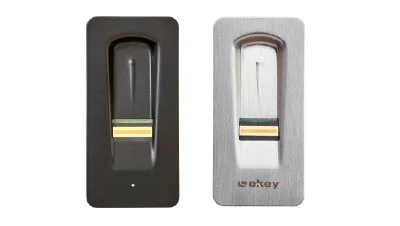
For many homeowners, the best advice is to keep the basics solid: a high-security exterior cylinder and an interior thumb-turn for quick exit. Plan power and placement early—some readers and strikes need low-voltage wiring, and choosing the location (panel, jamb, or handle) at order time avoids clunky surface add-ons.
On exposed façades, use weather-rated hardware and protect gaskets so the door stays air- and water-tight. For families, app-level permissions and lockable interior handles add a layer of control without hiding keys.
Choosing a handle that works with your door system
Start with compatibility, not looks. The handle should match the door’s construction, lock layout, and sealing so you don’t compromise insulation or create air leaks. OKNOPLAST uPVC front doors offer handle and pull-handle options and pair with 3-point automatic locks, EMTEK prep, and electric strikes—so hardware can be specified as part of the system, not as an add-on.
OKNOPLAST entry doors (e.g., TENVIS) are designed for long pull handles and advanced locking. TENVIS includes a secure 3-point lock as standard and supports electronic access; pull handles are offered in many lengths, and smart readers (eKey dLine, keypad, RFID) can mount on the panel or the handle, depending on the model.

What to check before you choose:
- Lock interface. Confirm the handle set aligns with the multi-point lock geometry and cylinder/escutcheon spacing. (OKNOPLAST front doors list 3-point automatic lock as a system feature.)
- Seals and gaskets. Use rosettes/reader housings with proper sealing so the perimeter gasket performance isn’t affected. (Automatic multi-point locks help maintain alignment and tightness.)
- Panel type and size. On full-height doors, longer pulls are available (multiple sizes across P10/Q90/P45B lines) to balance proportion and improve grip.
- Smart prep and placement. If adding fingerprint/RFID/keypad or a smart lock (e.g., Tedee), plan wiring/placement at order time; readers can be mounted on the door leaf, handle, or panel, and app/voice control is supported.
For a simple rule: select the handle as part of the complete door package—finish, length, fixing method, and smart access all specified together—so visual consistency and performance stay intact. By following those rules, you make sure your front doors (along with the handle) will work well for years to come.
The door handle is a small detail but has big impact
A front door handle sets the tone for your entry and supports how the door secures and operates every day. Choose a style that fits the panel (pull for tall, lever for compact), match the finish to nearby hardware, and confirm clean integration with a multi-point lock and any smart access you plan to use. If you need help in choosing the right front door for your home, visit one of OKNOPLAST trusted dealers. Our experts will guide you and help you choose the solution that will fit your home.
Lever handles are easier to use and offer a more modern look, but they rely on a strong lock (e.g., multi-point or deadbolt) for security. Doorknobs skew traditional and are harder to manipulate, though overall door security is determined more by the lock than the handle type.
Traditional handles are ornate and warm-toned (brass/bronze) with simple keyed mechanics; modern handles are sleek with durable finishes (stainless, matte black) and often support ergonomic designs and smart/keyless features. Pick based on your home’s style and how much tech and maintenance you want.
Top picks are stainless steel (maximum durability, low maintenance, modern look) and solid brass (long-lasting with a warm tone that can patina). Bronze is a strong third for rustic styles, while chrome, aluminum, and zinc alloy look good but trade off fingerprinting, rigidity, or long-term durability.

Let’s talk about your project!
Request a quote, discuss specifications, or get help choosing the right system
Send a request
"*" indicates required fields