


Front Door Replacement Trends Shaping 2026 Homes
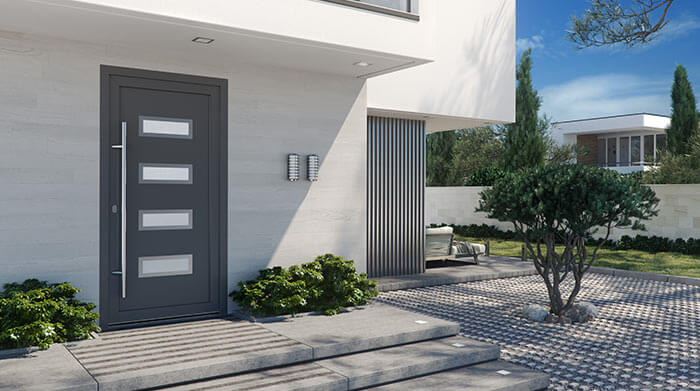

Front doors are having their own architectural moment in 2026 – oversized silhouettes, bold color, and invisible smart tech are replacing the flat, forgettable slab door of the past decade. This guide breaks down the six defining trends shaping entryway design, walks through the materials science behind door performance (uPVC, fiberglass, steel, and wood), and lays out exactly where Oknoplast’s product line fits – and where it doesn’t.
Key Takeaways:
- Six trends are redefining 2026 entryways: oversized silhouettes, textural fluting and ribbed glass, elongated hardware, bold color beyond black, invisible smart-lock technology, and natural material influence.
- Oversized single-slab doors (84–108 inches) are the era’s signature move – Oknoplast delivers these to exact project dimensions with no fixed size grid, though pivot mechanisms fall outside its current uPVC product line.
- Color has moved past all-black – moody teal, smoky jade, aubergine, and warm earth tones are the new statement choices, all available through Oknoplast’s factory-applied foil lamination.
- Security tech is disappearing into the door itself – biometric scanners, Z-Wave/Zigbee/Wi-Fi smart locks, and concealed video doorbells integrate without visible hardware, and Oknoplast’s multi-point espagnolette systems support smart-lock retrofits.
- Material choice comes down to real trade-offs, not marketing claims – Oknoplast’s uPVC achieves a U-Factor of 0.21–0.30, fiberglass wins on wood-grain aesthetics, and steel tops forced-entry resistance but risks thermal bridging without a proper thermal break.
- Oknoplast doors are not ENERGY STAR certified and do not qualify for the §25C tax credit – homeowners chasing that specific credit need to verify eligibility on the official ENERGY STAR product list before buying.
What Front Door Design Trends Are Shaping 2026 Home Entryways?
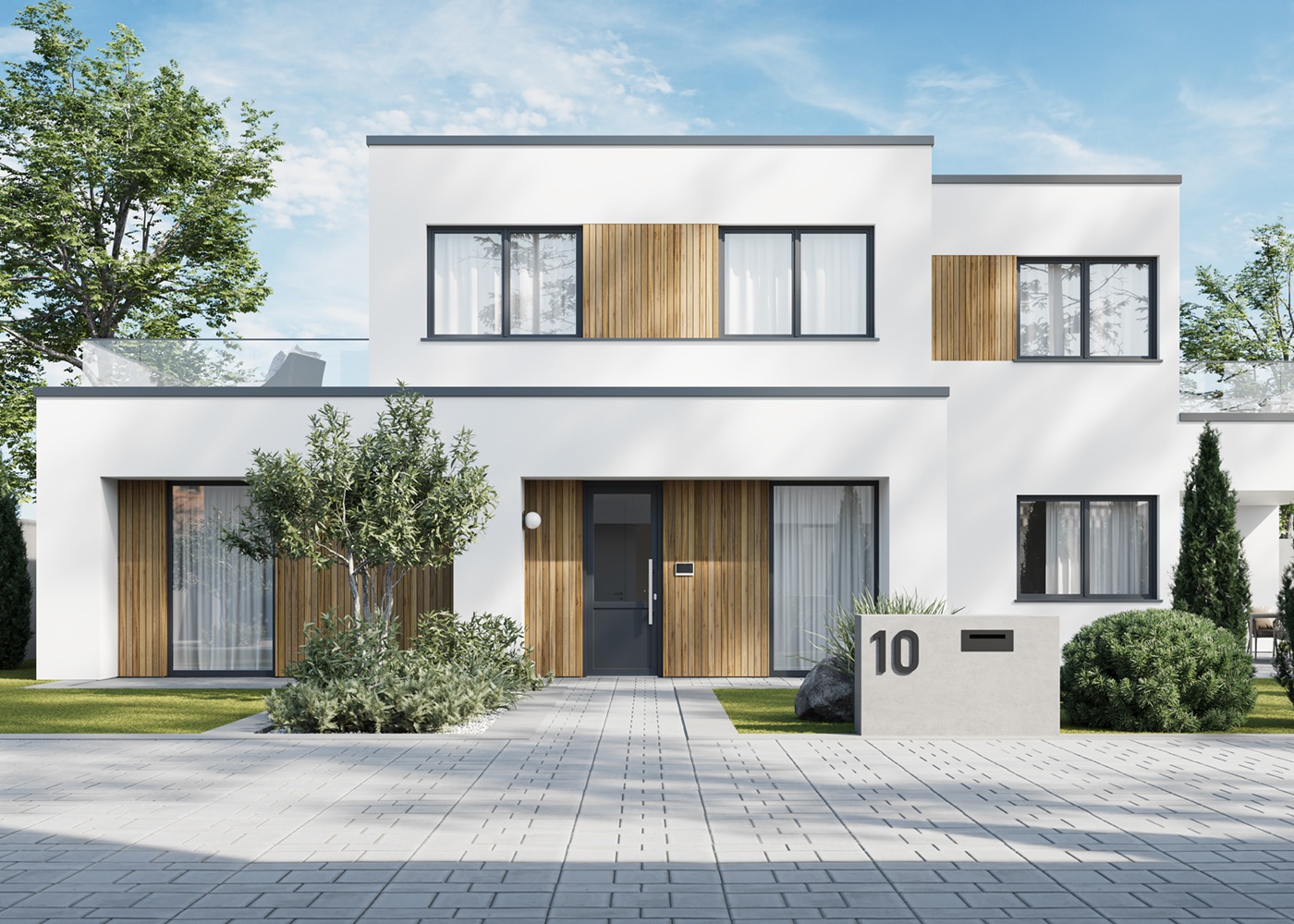
Six distinct trends are defining how we think about front door design in 2026: oversized statement silhouettes, textural fluted and ribbed surfaces, elongated hardware forms, moody color palettes moving beyond all-black, biocentric smart technology, and natural material influence. Together, they’re transforming the front door from a functional necessity into the architectural centerpiece of any home’s exterior.
This shift is fundamentally architectural. Where curb appeal once leaned on landscaping or facade color, the entry door now carries the visual weight of the entire front elevation – a standalone design object rather than an afterthought. Each of the six emerging trends reinforces this repositioning in its own way.
Oversized silhouettes lead the charge: pivot doors and tall single-slab doors exceeding 8 feet deliver the most immediate expression of architectural confidence in 2026 home decor forecasts. Textural treatments – asymmetrical fluting and ribbed glass sidelights in particular – add dimensional depth without relying on color contrast. At the detail level, elongated pull-bar hardware in geometric matte black or unlacquered brass replaces forgettable lever sets with a deliberate design signal.
Color is evolving just as boldly. Teals, jade greens, aubergines, and warm earth tones are displacing all-black as the go-to choice for doors that make a statement, bringing real chromatic specificity to innovative entry design. Security technology is following suit – fingerprint biometric scanners and smart locks now integrate directly into the door’s design language without visual interruption. Rounding out the picture, wood-look finishes and stone surrounds bring organic texture to the entryway, grounding even the most architectural compositions.
Oknoplast.us uPVC front doors are custom-manufactured to project dimensions, with factory-applied deep color finishes, multi-point locking hardware, and sidelight and transom configurations – making them a natural fit across all six 2026 trends at once.
| 2026 Trend | Design Expression | Oknoplast.us Application |
|---|---|---|
| Statement Silhouette | Single-slab doors exceeding 8 feet in height | Custom-manufactured uPVC front doors sized to project dimensions with transom configurations |
| Textural Surface | Asymmetrical fluting, ribbed glass sidelights adding dimensional depth | Available with sidelight panels extending the entry composition |
| Bold Color | Teals, jade greens, aubergines, warm earth tones replacing all-black | Factory-applied deep color finishes on uPVC profiles for consistent, durable coverage |
| Smart Technology | Biometric fingerprint scanners and smart locks embedded without visual disruption | Multi-point locking hardware compatible with smart lock integration at the entry |
How Do Oversized and Statement Door Silhouettes Redefine 2026 Curb Appeal?
Oversized door silhouettes are defining curb appeal in 2026 – from single-slab doors reaching 84-108 inches and floor-to-ceiling pivot mechanisms to asymmetrical sidelight arrangements and wide entry systems spanning 5-6 feet. These bold configurations are replacing the once-standard 80-inch hinged door. Oknoplast.us makes the single-slab, sidelight, and wide-entry versions of this trend achievable through millimeter-precise custom uPVC manufacturing with no fixed size grid; pivot mechanisms fall outside its current uPVC product line.
Oversized Single-Slab Height: 84, 96, and 108-Inch Doors as Facade Anchors
At 84, 96, or 108 inches tall, a single-slab door becomes the undeniable focal point of any facade. Every inch above the standard 80-inch threshold amplifies vertical proportion and communicates custom construction – a 96-inch door alone increases visible height by 20%, fundamentally shifting how the entryway relates to surrounding windows and cladding. Oknoplast.us delivers these statement heights to exact project dimensions, with no standard size grid imposing restrictions or additional costs. Factory-applied color finishes ensure full consistency across the entire oversized panel surface.
Pivot Door Mechanism: Floor-to-Ceiling Rotation as Architectural Drama
Rather than swinging from a side jamb, pivot doors rotate on a central or offset vertical axis – allowing a full-story slab to move with a balanced, dramatic motion that no conventional hinged door can match. Weight is distributed through floor and ceiling anchor points, making large-panel configurations structurally sound. This mechanism suits both sleek flat-facade designs and transitional styles with framed surrounds. Pivot doors fall outside Oknoplast’s current uPVC product line; its oversized-silhouette systems instead cover tall single-slab doors up to 108 inches and asymmetrical sidelight configurations.
Asymmetrical Sidelight Compositions and Wide Entry Systems
Pairing an oversized door with a single narrow sidelight on one side – and nothing on the other – reads as deliberate architectural intention rather than catalog convenience. Where symmetrical flanking pairs signal standard selection, asymmetry communicates project-specific design thinking, which is precisely what elevates a 2026 entryway beyond the ordinary. Wide entry systems, whether double doors or broad single slabs, achieve 5-6-foot clear openings that feel proportionally matched to open-plan interiors. Oknoplast.us millimeter-precision manufacturing makes both asymmetrical and wide-entry configurations possible without conforming to any fixed size grid.
| Silhouette Type | Defining Feature | Architectural Context |
|---|---|---|
| Oversized Single Slab | 84-108 inch height, millimeter-precise uPVC panel, factory color finish | Contemporary and transitional facades requiring a dominant vertical anchor |
| Pivot Door | Floor-to-ceiling vertical axis rotation, full-story slab height, floor/ceiling-anchored hinge system | Flat-facade modern and transitional architecture with high ceiling entries (specialized category outside Oknoplast’s uPVC product line) |
| Asymmetrical Sidelight | Unequal or single sidelight flanking, no fixed size grid, custom composition | High-design residential projects signaling bespoke architectural intent |
What Texture and Glass Trends – Fluted Panels and Ribbed Sidelights – Define 2026 Front Doors?
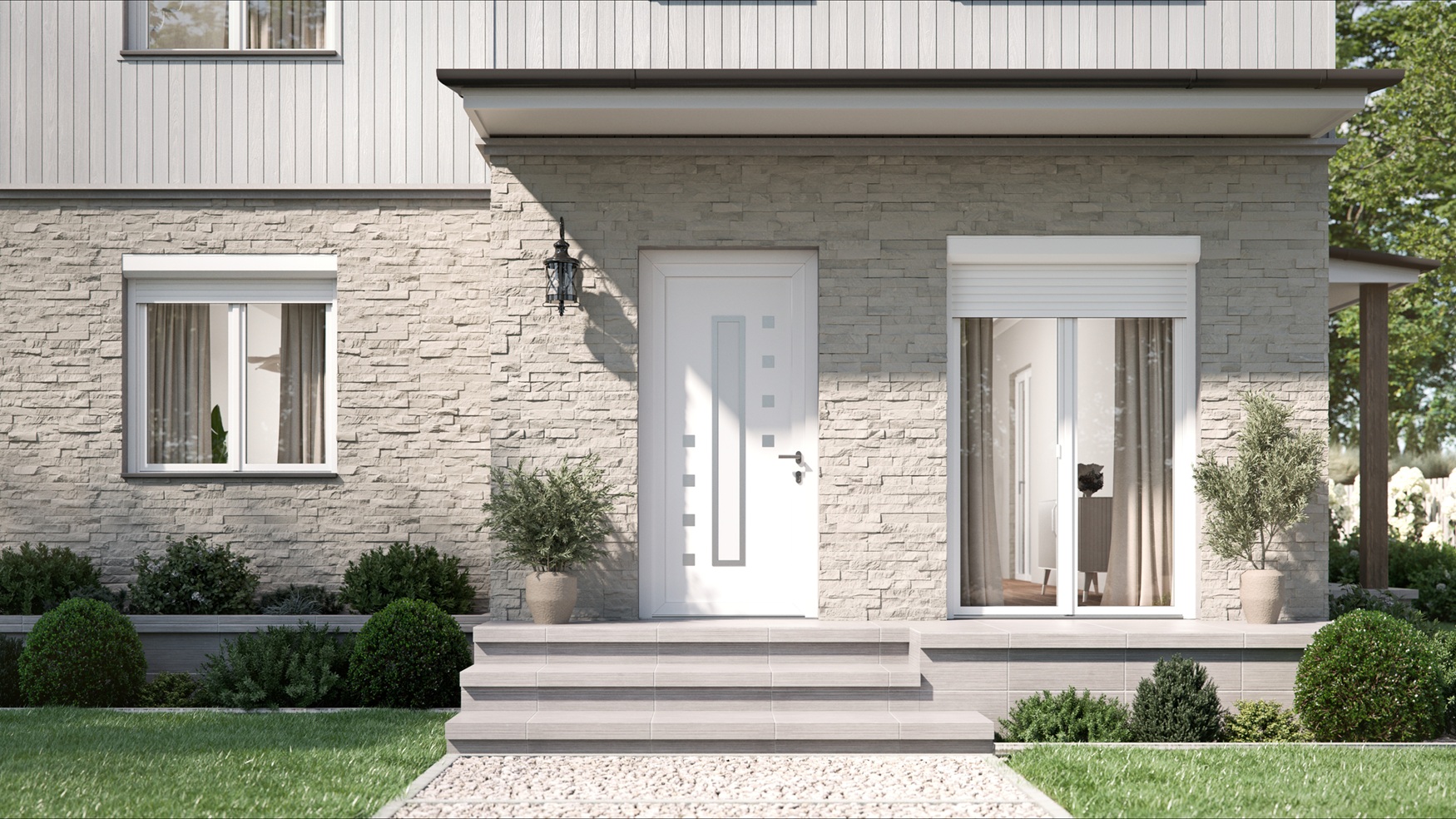
Two parallel trends are reshaping front door design in 2026: asymmetrical fluting carved into solid door panels that plays with light and shadow throughout the day, and ribbed or fluted glass in sidelights that balances privacy with natural light transmission. Together, they signal a definitive departure from the flat, featureless slab doors that dominated residential entries for the past two decades.
Asymmetrical Fluting on Solid Door Panels
Unlike uniform channel patterns, asymmetrical fluting uses vertical grooves of varying widths routed or molded directly into the door face – turning the surface itself into the design statement. As sunlight shifts angle throughout the day, these channels produce a dynamic interplay of light and shadow that adds genuine dimensional depth without any applied ornamentation. The technique works across multiple styles: wider channels reinforce the clean lines of contemporary entry systems, while narrower fluting echoes classical pilaster detailing in transitional applications. It stands as one of the defining surface treatments in forward-looking door design for 2026, effectively retiring the plain slab aesthetic that preceded it.
Ribbed Glass and Fluted Glass in Sidelights
Ribbed glass achieves something clear glass simply cannot – it diffuses interior light outward while keeping occupants visually shielded at the entry. The horizontal ribbing also creates a deliberate textural contrast between the solid door panel and its flanking glass, reinforcing the layered composition of the full entry system. Fluted glass takes a different approach, using broader vertical channels for a more pronounced texture with a distinctly contemporary character, making it well-suited to modern and transitional configurations alike.
Oknoplast.us offers ribbed and fluted glass among its standard specification options for sidelights and transoms, alongside clear, obscure, and other specialty glass types. All entry-adjacent glass meets applicable tempered safety glazing requirements for hazardous locations. For homeowners needing maximum opacity without sacrificing daylight, additional obscure patterns – rain, reed, and delta – round out the privacy-plus-light performance options.
| Texture Element | Description | Design Function | Privacy Level |
|---|---|---|---|
| Asymmetrical Fluting | Vertical channels of varying widths routed or molded into solid door panel face | Creates light-and-shadow dimensional depth throughout the day; replaces flat slab aesthetic | N/A – solid panel, full privacy |
| Ribbed Glass | Horizontal ribbing or reeding within sidelight glass pane | Diffuses light to exterior; provides texture contrast with solid door panel | High – obscures interior view while admitting light |
| Fluted Glass | Broader vertical channels within sidelight glass pane | Pronounced texture; contemporary and transitional entry character | High – obscures interior view with more defined channel pattern |
The ability to customize across both categories – fluting depth, ribbed glass orientation, and channel width – allows the 2026 entry system to read as a unified architectural composition rather than a set of disconnected parts.
Which Hardware Finishes and Pull Bar Styles Are Trending for 2026 Entry Doors?
In 2026, entry door hardware has evolved into a sculptural statement in its own right. Elongated pull bars – ranging from 24 to 48 inches – are proportionally scaled to oversized doors, while finish choices span unlacquered brass with its natural patina, ever-reliable matte black, and PVD anti-fingerprint coatings in matte and brushed variants. Oknoplast.us takes integration a step further with factory-fitted multi-point locking and flush pull bars pre-routed directly into the door profile.
Elongated Pull Bar Trend: Proportional Logic and Visual Effect
Gone are the days of the standard 12-inch lever handle. Today’s oversized entry doors call for pull bars measuring 24 to 48 inches – a scale that creates visual continuity across the entire door face. Their vertical alignment with door height produces a clean architectural line that strengthens curb appeal without relying on extra cladding or ornament. Squared and faceted cross-sections have largely replaced the rounded profiles of traditional handles, giving each bar a geometric character that reads as an exterior design feature rather than a functional afterthought.
Four Trending Finishes for 2026 Entry Door Hardware
Unlacquered brass remains a top choice for transitional and warm-contemporary facades, valued precisely because it ages – developing a living patina that personalizes the entry over time. Matte black holds its position as the contemporary standard, versatile enough to pair with steel, dark wood, and fiber-reinforced door skins across virtually any climate. For a cooler, more refined tone, satin nickel complements modern aluminum-look profiles particularly well. Oil-rubbed bronze, meanwhile, bridges the gap between traditional and contemporary, making it a natural fit for craftsman and cottage-style configurations.
For high-traffic entries facing UV exposure and moisture, PVD coatings in matte black and brushed gold offer a durability that surface-applied lacquers simply can’t match – delivering lasting scratch resistance and finish stability where it matters most.
Oknoplast.us Factory-Fitted Hardware Integration
Oknoplast.us factory-fitted multi-point espagnolette locking brings handle sets and flush pull bars together seamlessly, with bars pre-routed into the door profile itself – eliminating the surface-mount gap that typically shows on field-installed hardware. Elongated pull bars are available as a specification option, so contractors and homeowners can match hardware scale to door height at the manufacturing stage rather than working around limitations during installation.
| Hardware Trend | Finish / Style | Best Pairing With |
|---|---|---|
| Elongated Pull Bar (24-48 in) | Matte black, brushed gold PVD | Oversized modern entry doors, dark wood or steel skins |
| Unlacquered Brass | Living patina (uncoated) | Warm-contemporary and transitional facade styles |
| PVD Matte Black | Physical vapor deposition, scratch-resistant | High-traffic entries, UV-exposed and moisture-prone climates |
What Color Palettes – Moody Teal, Smoky Jade, and Warm Earth Tones – Dominate 2026 Front Door Trends?
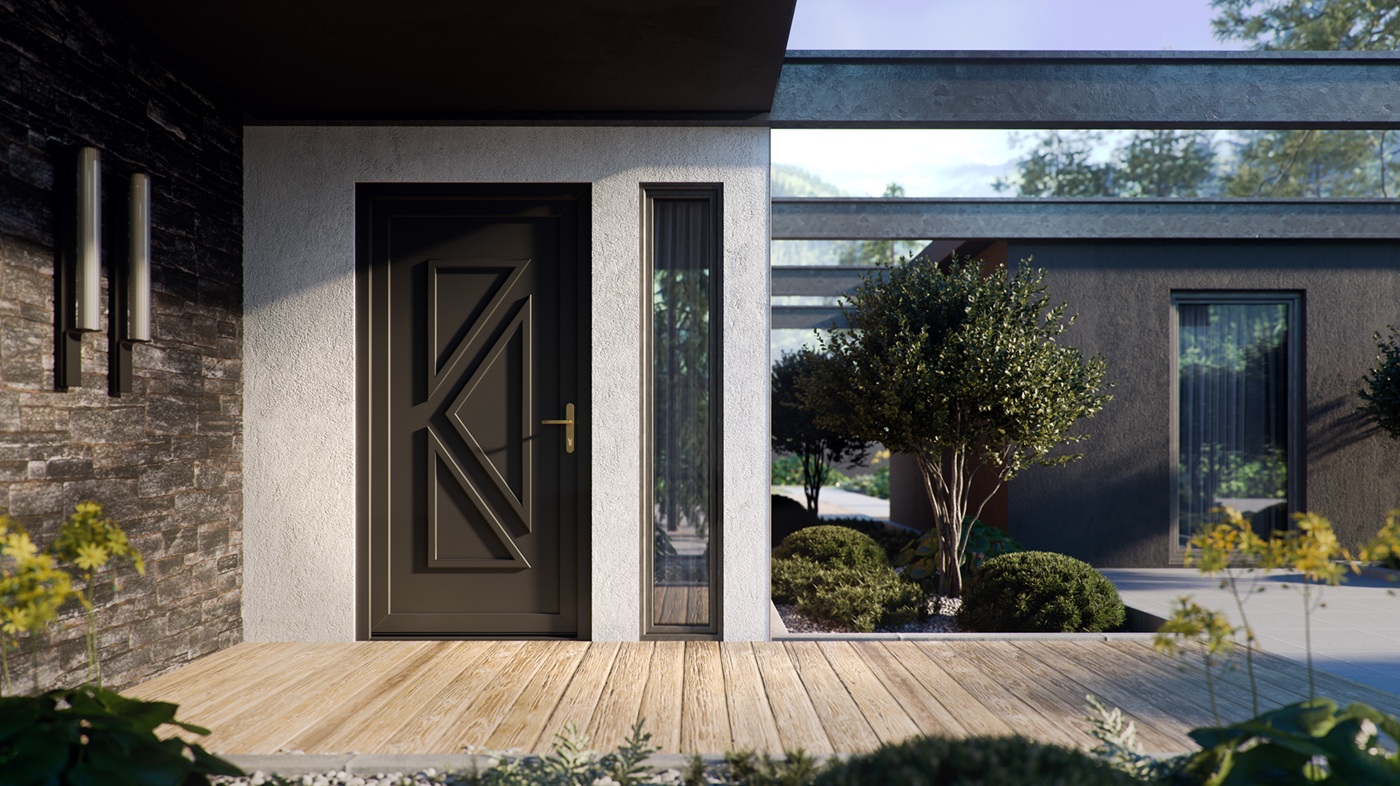
Front door color in 2026 is moving well past the all-black standard, embracing richer, more complex hues. Moody teals, smoky jade greens, deep aubergine, and warm earth tones like terracotta and clay are all stepping in as the new statement choices for curb appeal – each bringing more personality than predictable black ever could.
Moody teals blend deep blue-green pigment with substantial gray content, landing somewhere that’s neither purely blue nor purely green. That gray undertone keeps the color grounded and architecturally flexible – equally at home on a contemporary flat-facade as on a traditional clapboard exterior. Pair it with crisp white trim for sharp contrast, or warm greige for something softer and more current.
Smoky jade greens layer gray and black undertones over a green base, creating an organic, naturalistic quality that visually ties the front door to surrounding stonework and landscaping. This earthy register works especially well alongside wood or stone surrounds, where it complements rather than competes with the material palette.
Rich aubergine – a deep purple-brown warmed by red undertones – delivers genuine drama without tipping into garish territory, particularly when set against stone surrounds or natural wood casing. It ranks among the highest-impact 2026 front door choices for traditional and transitional homes.
Warm earth tones – terracotta, clay, warm taupe – are a natural extension of the farmhouse and natural materials movement in residential design. Applied to front doors, they create visual continuity with board-and-batten siding, brick, and limewashed stucco, making the entry feel like part of a cohesive whole rather than an afterthought.
Black remains a solid baseline in 2026, though the shift is away from flat matte toward satin and gloss finishes that carry genuine depth and reflect light. This evolution keeps black competitive alongside the more complex palettes emerging this year, adding dimension that matte simply can’t deliver.
Oknoplast.us colors its front door profiles through factory-applied foil lamination and co-extrusion – never field painting. The standard palette covers white, anthracite, and golden oak woodgrain, with custom RAL colors available for the door leaf. Because the finish is factory-applied, it holds its integrity across decades with no repainting required.
| Color Palette | Undertones | Best Architectural Context | Trim Pairing |
|---|---|---|---|
| Moody Teal | Deep blue-green with significant gray content | Contemporary flat-facade and traditional clapboard exteriors | Crisp white (high contrast) or warm greige (softer contemporary) |
| Smoky Jade | Green base with gray and black undertones | Homes with wood or stone surrounds, landscape-connected entries | Warm greige or natural wood casing |
| Rich Aubergine | Deep purple-brown with red undertones | Traditional and transitional architecture with stone or wood surrounds | Crisp white trim or natural stone casing |
| Warm Earth Tones | Terracotta, clay, and warm taupe – no cool gray content | Farmhouse, brick, board-and-batten, limewashed stucco exteriors | Warm greige or natural wood trim |
How Do Smart Locks and Connected Technology Upgrade Front Door Security in 2026?
Front door security in 2026 is defined by biocentric technology – think fingerprint scanners hidden within handles, smart locks controllable via app across Z-Wave, Zigbee, and Wi-Fi, and video doorbells tucked invisibly into door surrounds. Oknoplast.us multi-point espagnolette systems are fully compatible with these retrofit smart lock upgrades through flush-mount electronic cylinders.
Biocentric Integration: Invisible Tech in Innovative Door Designs
Rather than bolting hardware onto the surface, biocentric integration weaves smart security directly into the door itself – no exposed keypads, no visible mechanisms, no aesthetic trade-offs. Fingerprint scanners sit flush inside the handle or frame, completely invisible until touched. Simply place a finger on the sensor and you’re in, no phone, key, or code required. This seamless approach has become the hallmark of 2026 door design, where security hardware quietly disappears into the profile.
Smart Lock Platforms: Z-Wave, Zigbee, and Wi-Fi Integration
Today’s smart locks speak three wireless languages – Z-Wave, Zigbee, and Wi-Fi – making them compatible with Alexa, Google Home, and Apple HomeKit. From a smartphone, you can grant guest access remotely or trigger auto-lock after a set time interval, tightening security without changing anyone’s habits. Installation is straightforward: most units run on batteries for easy retrofitting, though hardwired options exist for continuous power. Adapter hardware bridges electronic strike mechanisms with European multi-point systems, so multi-point doors aren’t left out of the equation.
Oknoplast.us Multi-Point Espagnolette Compatibility
Oknoplast.us multi-point espagnolette systems accommodate smart lock upgrades through flush-mount electronic cylinders, available as a specification upgrade across Oknoplast door profiles. Video doorbells follow the same philosophy – concealed within the door surround rather than strapped to the surface – preserving the door’s clean architectural line while delivering full camera and intercom capability.
| Technology | 2026 Specification | Smart Home Compatibility |
|---|---|---|
| Biometric Scanner | Flush-mounted in door handle or frame; keyless fingerprint recognition access | Standalone operation; integrates with app-controlled smart lock platforms |
| Smart Lock | Z-Wave / Zigbee / Wi-Fi enabled; auto-lock configurable; battery or hardwired | Alexa, Google Home, Apple HomeKit; adapter hardware for multi-point espagnolette |
| Video Doorbell | Concealed flush in door surround; no surface-mount hardware visible | Wi-Fi connected; integrates with Alexa, Google Home, Apple HomeKit ecosystems |
How Does Front Door U-Factor Affect Energy Performance and ENERGY STAR Thresholds?
The U-Factor of a front door measures heat loss across the entire door assembly. Under ENERGY STAR Version 7.0, certified opaque (solid) exterior doors must meet a U-Factor threshold of ≤0.17 BTU/(hr·ft²·°F); doors with glass panels are held to somewhat higher thresholds. Oknoplast does not hold ENERGY STAR certification, meaning its front doors do not qualify for the §25C tax credit – homeowners seeking eligible products should verify the certified product list at energystar.gov.
A door’s U-Factor reflects heat transfer across every component: the core, the uPVC or other frame material, any glazing inserts, and the perimeter gasket system. Simply put, a lower value means better insulation and lower heating costs. Four key variables shape this figure:
- the type of core insulation (polyurethane foam vs. polystyrene),
- frame depth and chamber count,
- glazing specification,
- the compression quality of the perimeter seal.
ENERGY STAR’s ≤0.17 BTU/(hr·ft²·°F) threshold for opaque doors is notably more demanding than the equivalent window requirement, reflecting the greater thermal burden placed on solid assemblies in cold climates. Doors with glass panels, such as sidelight or transom configurations, are held to somewhat higher thresholds since added glazing changes the assembly’s thermal profile.
Because Oknoplast doors are not enrolled in the ENERGY STAR program and are not listed on energystar.gov, they do not qualify for the §25C Energy Efficient Home Improvement Credit. Homeowners planning to claim that credit – worth 30% of product cost, up to $500 per year – must confirm eligibility on the ENERGY STAR certified product list before making a purchase.
That said, Oknoplast uPVC front doors are built to deliver genuine thermal performance. Multi-chamber uPVC profiles with steel reinforcement, insulated door leaf cores, and EPDM compression gaskets activated by multi-point locking all target the same heat-loss pathways that U-Factor measures. Customization choices such as panel configurations, glazing inserts, and color finishes don’t compromise that thermal integrity – making these doors a capable option for energy-conscious homeowners, even outside the §25C framework.
| Door Type | Door U-Factor Threshold BTU/(hr·ft²·°F) | Oknoplast Certification Status |
|---|---|---|
| Opaque (solid) | ≤0.17 | Not ENERGY STAR certified – not listed on energystar.gov |
| Glazed (sidelight/transom) | Higher (varies by glass area) | Not ENERGY STAR certified – not listed on energystar.gov |
uPVC vs. Fiberglass vs. Steel: Comparing Front Door Materials for Durability and Energy Efficiency
When choosing a front door, three materials dominate the market – uPVC, fiberglass, and steel – each with its own strengths and compromises. Oknoplast’s uPVC achieves a U-Factor of 0.21-0.30, backed by factory-applied color and steel-reinforced multi-point locking. Fiberglass wins on aesthetics, replicating wood-grain texture with exceptional dimensional stability, while steel offers the toughest forced-entry resistance, though it risks thermal bridging if the frame lacks a proper thermal break.
Oknoplast uPVC doors are built around multi-chamber uPVC profiles with embedded steel reinforcement and an insulated core. The steel inserts add structural rigidity for European-style multi-point espagnolette locking – engaging the frame at multiple perimeter points at once – without causing thermal bridging, since the steel stays encased within the uPVC chamber rather than spanning the full frame cross-section. Factory foil lamination delivers lasting color finishes that never need repainting, and because the material is completely moisture-proof, there’s no risk of rotting, warping, or rusting. Depending on core and glazing specifications, U-Factor values range from 0.21 to 0.30.
Fiberglass doors feature a molded skin over a polyurethane foam core, landing in the 0.18-0.25 U-Factor range. That molded skin precisely replicates wood grain, making fiberglass the go-to choice for homeowners who want a stainable, paintable wood look combined with reliable dimensional stability – particularly in high-humidity climates where real wood would eventually warp.
Steel doors, built with galvanized or stainless skins over insulated cores, achieve U-Factors of roughly 0.15-0.25 and top the charts for forced-entry resistance. Their key vulnerability, however, is thermal bridging: steel frames without a thermal break conduct heat directly through the structure, undermining energy efficiency in colder US climate zones.
Wood remains the sentimental benchmark – unmatched in natural warmth and aesthetic richness, but demanding in upkeep. Regular painting, sealing, and moisture management are non-negotiable, and over time, thermal movement and rot become real concerns.
| Material | U-Factor Range | Maintenance | Security | Aesthetic Options |
|---|---|---|---|---|
| uPVC (Oknoplast) | 0.21-0.30 | No painting; factory foil lamination; moisture-proof | Multi-point espagnolette locking; steel-reinforced profile | Factory-applied colors; custom sizing; modern entry door designs |
| Fiberglass | 0.18-0.25 | Paintable and stainable; low maintenance | Good; dependent on locking hardware | Wood-grain texture; smooth finish; innovative door designs |
| Steel | 0.15-0.25 | Dent-susceptible; periodic refinishing | Highest forced-entry resistance | Limited; embossed panels; paint-ready surface |
| Wood | Varies; typically higher (worse) | Highest; painting, sealing, moisture protection required | Moderate; dependent on hardware | Warmest natural aesthetic; fully customizable grain |
Oknoplast.us front doors bring together uPVC multi-chamber energy performance (U-Factor as low as 0.21), custom sizing, factory color finishes that never need touching up, multi-point locking security and US shipping – covering all four pillars of modern entry door selection in a single, well-engineered package.
Six trends dominate in 2026: oversized silhouettes, textured surfaces with asymmetric fluting, elongated hardware, bold color palettes beyond standard black, smart biometric technology, and the influence of natural materials. Together, these elements turn the front door into the architectural focal point of the facade.
Pivot doors rotate around a vertical axis positioned centrally or offset, allowing a full, dramatic swing of a sash that can span an entire story in height. The mechanism distributes weight to the floor and ceiling, giving large panels the stability they need, and suits modern and transitional architectural styles particularly well. Oknoplast’s uPVC front door line does not currently include pivot mechanisms; its oversized-silhouette options focus on tall single-slab doors up to 108 inches and asymmetrical sidelight configurations.
Yes, Oknoplast.us multi-point locking systems are compatible with smart locks running on Z-Wave, Zigbee, and Wi-Fi platforms. They can be fitted with biometric fingerprint readers and cameras or video doorbells concealed within the frame, delivering a modern, secure, and visually clean solution.
Popular shades in 2026 include deep teal, smoky jade green, dark eggplant, and warm earth tones like terracotta and clay. These colors are replacing traditional black, bringing bolder, more personalized accents to the facade.
uPVC doors, such as those offered by Oknoplast, achieve a U-Factor of 0.21-0.30 thanks to multi-chamber profiles and insulated cores. Fiberglass and steel also offer good insulation, but uPVC stands out for its durability and moisture resistance without the need for repainting.
Oversized-silhouette front doors in 2026 can range from 84 to 108 inches (roughly 213 to 274 cm) in height. These dimensions emphasize the entrance’s architectural presence and are achievable through Oknoplast’s precision custom manufacturing.
Elongated, geometric handles are trending in 2026, in finishes such as matte black, unlacquered brass that develops a natural patina, and fingerprint-resistant PVD coatings. Oknoplast offers factory-installed multi-point locking systems with this hardware, adding both aesthetics and durability.


Let’s talk about your project!
Request a quote, discuss specifications, or get help choosing the right system
Send a request
"*" indicates required fields