


Tilt and Turn Windows: Operation, Energy Performance, and Security

Key Takeaways:
- Tilt and turn windows deliver air infiltration below 0.10 CFM/ft² at 25 Pa (ASTM E283) – 3 to 5 times lower than double-hung windows (0.30-0.50 CFM/ft²) – because multi-point locking draws the sash against compression seals at 5 to 7 points around the full perimeter, not just at the handle.
- The OKNOPLAST PAVA system achieves U-Factor as low as 0.14 with triple glazing. Frame color has no effect on this rating; a black PAVA and a white PAVA carry identical NFRC values.
- Frame color does not affect §25C Energy Efficient Home Improvement Credit eligibility. The credit provides up to $600 per exterior window unit for NFRC-certified products meeting ENERGY STAR Most Efficient criteria – are designed to meet these thresholds pending EPA certification.
- Tilt and turn windows open inward and require interior clearance equal to approximately the window’s full width when in turn mode. A 36”×60” window needs roughly 36 inches of clearance from the wall to the nearest furniture. Standard window treatments obstruct operation unless sash-mounted or fully retractable.
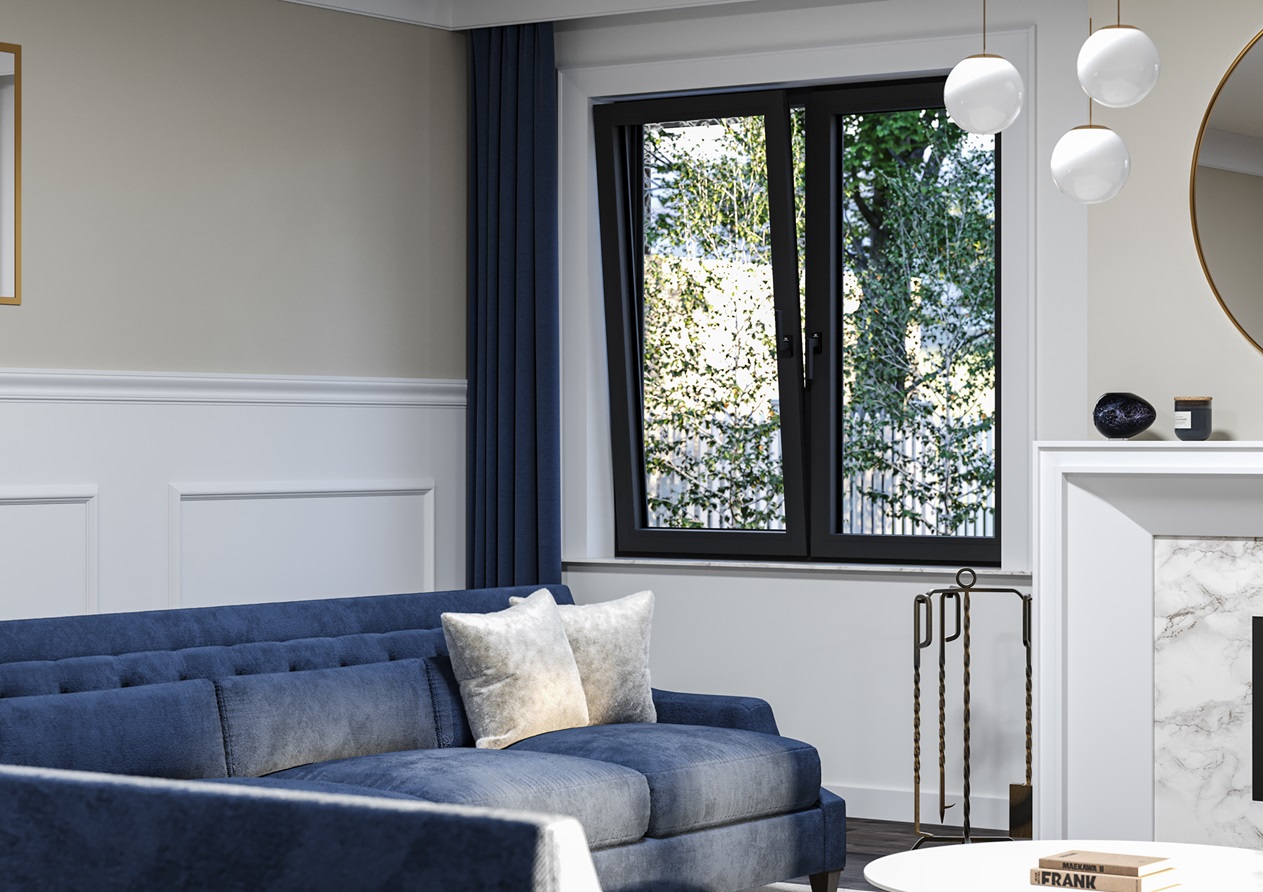
Tilt and turn windows are a single-handle, dual-function window type standard in European residential and commercial construction for over 50 years – and increasingly specified in U.S. high-performance residential projects. A single handle rotation controls three positions: locked, tilt (top-inward ventilation), and turn (full inward swing). The performance advantage over American window types comes from a mechanical fact: multi-point locking draws the sash against full-perimeter compression seals simultaneously, producing air infiltration values that no single-point lock system can match.

How do tilt and turn windows work – tilt mode, turn mode, and micro-ventilation?
A tilt and turn window operates through 3 distinct handle positions that control both ventilation and security simultaneously – a mechanical design developed in Central Europe in the 1950s that is now standard in European residential construction. The entire system is controlled by a single lever handle that rotates between 0° (locked), 90° (tilt), and 180° (turn) – though the exact angles vary by hardware manufacturer.
Locked position (handle at 0°)
A central gearbox connects to 5-7 shoot bolts and compression rollers around the sash perimeter; when the handle reaches 0°, all points engage simultaneously, drawing the sash against compression gaskets on all four sides. No single-point lock system produces equivalent perimeter seal pressure, which is why tilt and turn air infiltration (<0.10 CFM/ft²) is 3-5× lower than a double-hung window of equivalent size and specification.
Tilt mode (handle at 90°)
The sash rotates inward from the top on a horizontal axis at the bottom, opening 4 to 6 inches at the head. This creates controlled draft-free ventilation – incoming air enters from above and diffuses downward, reducing direct drafts at occupant level. Rain runs off the tilted sash rather than entering the opening. The bottom pivots remain engaged, so the window cannot be pushed further open from outside. This position is also child-safe and pet-safe: the opening is too narrow for passage.
Turn mode (handle at 180°)
The sash swings fully inward on a vertical axis, like a door, opening to approximately 90° from the wall plane. In this position, the window provides maximum airflow, serves as an emergency egress opening, and allows cleaning of both glass surfaces from inside. A standard 30”×60” tilt and turn window in turn mode provides approximately 12.5 square feet of net clear opening – well above the IRC R310 minimum of 5.7 square feet required for bedroom egress windows.
Micro-ventilation (effiAIR position)
OKNOPLAST’s effiAIR feature adds a fourth position: a 1/4-inch perimeter gap created when the sash is slightly separated from the frame without tilting. This creates continuous low-level air exchange without fully activating the tilt mechanism – relevant for Passive House and high-performance projects where continuous background ventilation is part of the IAQ strategy, such as PHIUS or ASHRAE 62.2 compliance. The window remains locked in this position; the gap is not accessible from outside.
How does multi-point locking create airtight seals – and how does air infiltration compare to double-hung?
Tilt and turn windows with multi-point locking deliver measured air infiltration below 0.10 CFM/ft² at 25 Pa differential pressure (ASTM E283) – compared to 0.30-0.50 CFM/ft² for double-hung and 0.30-0.60 CFM/ft² for horizontal sliders. This 3 to 5× difference is structural, not material: it comes from the locking mechanism, not the frame composition.
A double-hung window uses a lift latch or cam lock at one point on the meeting rail. When latched, the two sashes press against each other at the center, but the sides, head, and sill rely on pile weatherstripping – a brush-like material that compresses loosely and allows air movement. Over time, pile weatherstripping compresses permanently and infiltration increases further.
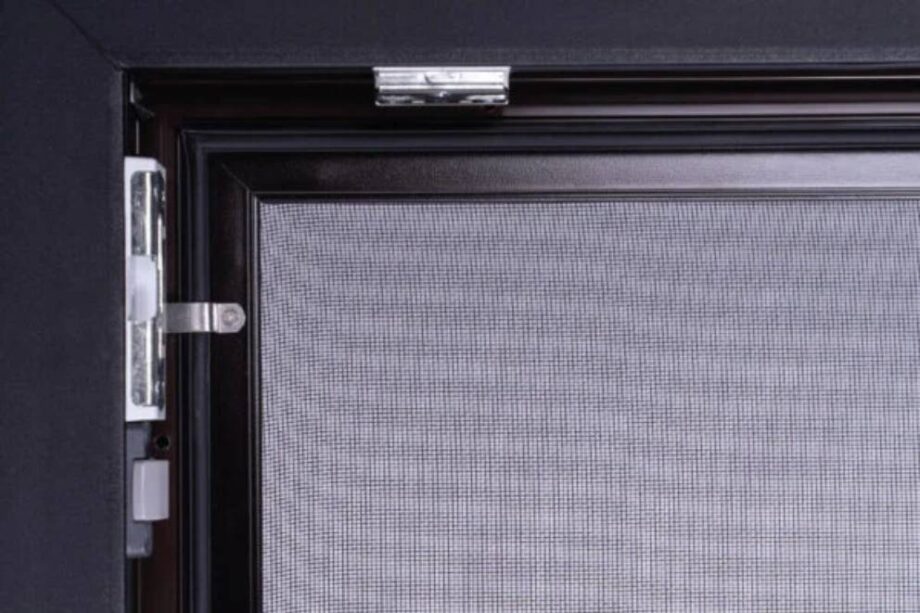
A tilt and turn window uses a gearbox connected to shoot bolts, compression rollers, and keep hooks distributed at 5 to 7 points around the sash perimeter. When the handle rotates to the locked position, all points engage simultaneously, drawing the sash uniformly against EPDM or TPE compression gaskets on all four sides. Compression gaskets maintain consistent seal pressure under thermal cycling, unlike pile weatherstripping. The result is a perimeter seal that functions like a refrigerator door gasket rather than a brush.
| Window type | Air infiltration (ASTM E283, 25 Pa) | Lock points | Seal type |
| Tilt and Turn (multi-point) | <0.10 CFM/ft² | 5-7 points around perimeter | Compression seals, full perimeter |
| Casement (single-point) | 0.15-0.30 CFM/ft² | 1 point (handle side) | Partial perimeter |
| Double-hung (sash-on-sash) | 0.30-0.50 CFM/ft² | Lift latch only | Pile weatherstripping |
| Single-hung | 0.30-0.50 CFM/ft² | Lift latch only | Pile weatherstripping |
| Horizontal slider | 0.30-0.60 CFM/ft² | Latch only | Pile weatherstripping |
The OKNOPLAST PAVA and PIXEL systems meet the <0.10 CFM/ft² threshold per ASTM E283 testing. The air infiltration advantage translates directly to thermal comfort and heating/cooling costs. At 0.10 CFM/ft², a 36”×60” window passes approximately 6.3 cubic feet per minute of conditioned air to the outside at 25 Pa differential pressure (ASTM E283 test condition). The equivalent double-hung at 0.40 CFM/ft² passes approximately 25 cubic feet per minute – roughly 4× more air loss through the same opening. Per DOE Building Technologies Office data, air infiltration through windows and doors accounts for 25-40% of residential heating and cooling energy loss.
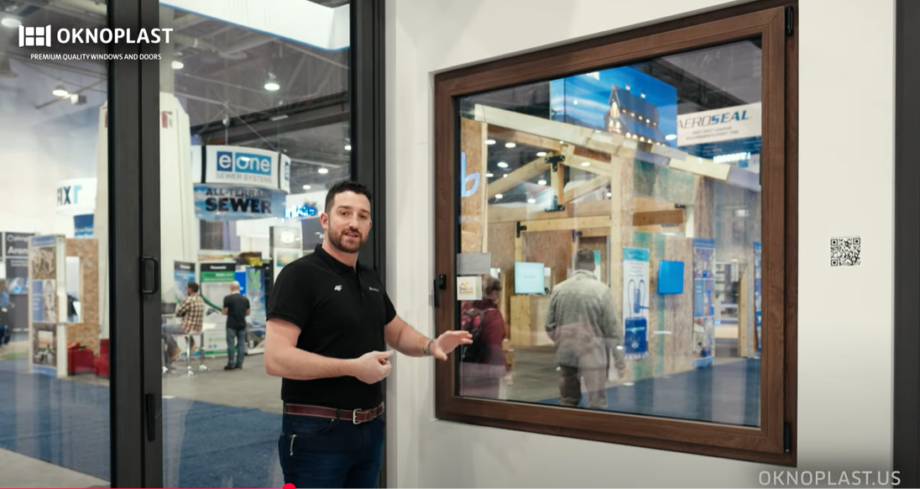
Check how amazing ventilation options the PAVA system by OKNOPLAST provides:
What U-Factor and SHGC ratings do tilt and turn windows achieve – and which ENERGY STAR zones do they meet?
NFRC-certified tilt and turn windows in the OKNOPLAST line achieve U-Factor as low as 0.14 with triple glazing – placing them in PHIUS passive building compliance territory for most Climate Zone 5-8 configurations. ENERGY STAR Northern zone requires U-Factor ≤0.27; Most Efficient requires ≤0.20. The PAVA system with standard triple-pane glazing meets the 0.20 Most Efficient threshold.
SHGC (Solar Heat Gain Coefficient) and U-Factor are rated separately on the NFRC label, and optimum targets differ by climate zone and window orientation. For Climate Zones 1-3, the primary concern is limiting solar gain in cooling-dominated climates; ENERGY STAR requires SHGC ≤0.25 for Southern and South-Central zones. For Climate Zones 5-8, higher SHGC (0.25-0.40) can reduce heating loads through passive solar gain. PAVA is available with glazing packages optimized for both orientations.
| OKNOPLAST system | U-Factor range | ENERGY STAR zone(s) | Most Efficient? | §25C up to |
| PAVA (uPVC, triple-pane) | 0.14-0.26 | Meets U-Factor threshold all 4 zones (pending EPA) | Yes – Northern ≤0.20 | $600/unit |
| PAVA Light (double-pane) | 0.25-0.27 | Northern, N-Central | Verify per config. | $600/unit |
| PAVA Impact (HVHZ Zone 4) | Verify per glazing | Verify per config. | Verify per config. | $600/unit if ME |
| PIXEL (uPVC, slim sash) | 0.16-0.29 | N-Central, S-Central, Southern | Partial – not all zones | $600/unit if NFRC ME |
| MIRU EVO Hidden (aluminum) | Verify per data sheet | Verify per glazing | Verify per config. | $600/unit if ME |
All figures in the table assume NFRC-certified configurations. U-Factor varies by glazing package, sash size, and frame-to-glass ratio – smaller windows have higher frame fraction and consequently higher whole-unit U-Factor. Verify the specific configuration’s NFRC label before permit submission or tax credit claim. ENERGY STAR status is pending EPA approval; confirm at time of purchase.
How secure are tilt and turn windows – and what is Burglar Resistance Class RC3?
Tilt and turn windows with 5-7 locking points around the perimeter cannot be forced open by prying at a single point – all locking points must disengage simultaneously for the window to open. This is why RC3 certification (EN 1627: resistance to experienced attack for 5 minutes) is achievable in a tilt and turn configuration but rarely in single-point casement or double-hung designs. In tilt mode, the bottom pivots remain engaged even when the top portion is open, making the window impossible to push fully open from outside without breaking the glass.
European Burglar Resistance Classes (EN 1627) provide a standardized test protocol for window and door security. The classes range from RC1 (basic resistance to physical body pressure) to RC6 (protection against high-powered tools and explosives). RC2 and RC3 are the residential security specifications most relevant to U.S. buyers:
- RC2: resists attack with simple tools (screwdrivers, crowbars) for 3 minutes. Standard for most residential applications. Requires reinforced hardware with anti-drill protection.
- RC3: resists attack with a heavier tool set (hammers, chisels, wedges) for at least 5 minutes. Required for ground-floor units, corner exposures, or high-security residential specifications. Requires reinforced frame profiles, laminated glass, and upgraded multi-point hardware.
No comparable standard exists in the U.S. residential window market – AAMA security ratings cover hardware performance but not the full assembly under attack. RC3 certification covers the complete system: glass, frame, hardware, and installation connection to the wall. OKNOPLAST windows can be specified with RC2 and RC3 hardware packages where project security requirements call for it. Verify specific product certification numbers with the dealer.
Steel reinforcement in the PAVA uPVC frame – galvanized inserts pressed into load-bearing chambers – contributes to both structural rigidity under wind load and resistance to frame deformation during forced entry attempts. The steel is not visible from either face of the window; it is entirely enclosed in the uPVC profile.
How do frame materials – uPVC, aluminum, and wood-hybrid – compare for tilt and turn windows?
Four frame materials are used for tilt and turn windows in the U.S. market – uPVC (82mm typical depth, U-Factor 0.17 W/m·K conductivity), thermally broken aluminum (50-70mm, ~1.5-2.0 W/m²K frame U-Factor), fiberglass, and wood-aluminum clad hybrid. The choice is not primarily aesthetic – it is driven by project energy requirements, climate zone, and design brief.
| Material | U-Factor (frame) | Profile depth | Maintenance | Best for | OKNOPLAST |
| uPVC (vinyl) | 0.25-0.35 | 82mm (PAVA) | Very low – no painting | Cold/mixed climates, cost-sensitive | PAVA, PIXEL |
| Thermally broken aluminum | 0.35-0.55 | 50-70mm | Low – powder coat | Modern design, large formats | MIRU EVO line |
| Wood-aluminum clad | 0.20-0.35 | Varies | Low exterior / moderate interior | Traditional/luxury, historic | Not in OKNOPLAST US line |
| Fiberglass | 0.25-0.35 | Varies | Very low | All climates, premium residential | Not in OKNOPLAST US line |
uPVC frames at 82mm depth (PAVA) provide inherently low thermal conductivity because uPVC is a poor conductor of heat – approximately 0.17 W/m·K vs. 160 W/m·K for aluminum. Steel reinforcement inside the profile carries structural loads without adding thermal conductivity because the steel is surrounded by uPVC chambers. The multi-chamber profile creates a series of air pockets that further limit heat transfer.
Thermally broken aluminum uses polyamide (PA66-GF) or polyurethane bridges to interrupt the aluminum section, reducing frame U-Factor from ~5.0 W/m²K (non-broken aluminum) to ~1.5-2.0 W/m²K. The bridge material, geometry, and width determine how much of the thermal bridge is interrupted. MIRU EVO aluminum systems use PA66-GF thermal breaks; the structural rigidity of the geometry – not lower conductivity than polyurethane – is the primary performance advantage of this configuration.
For Climate Zones 5-8, uPVC with triple glazing (PAVA) is typically the specification that meets PHIUS compliance targets and is designed to reach ENERGY STAR Most Efficient U-Factor thresholds – confirm certification status at time of purchase. For contemporary architecture with large-format glazing and slim profiles, thermally broken aluminum (MIRU EVO) is the specification that achieves the visual requirement while maintaining adequate thermal performance. Wood-hybrid is specified when interior aesthetics require natural wood finish and exterior weather protection requires aluminum cladding.

Does the §25C Energy Efficient Home Improvement Credit apply to tilt and turn windows?
Yes – OKNOPLAST tilt and turn windows qualify for the §25C Energy Efficient Home Improvement Credit (IRS, tax year 2025) on the same terms as any other window type. The credit provides up to $600 per exterior window unit, with a $1,200 annual household cap, for NFRC-certified products meeting ENERGY STAR Most Efficient criteria. Frame color, operation type, and origin (domestic or imported) have no effect on eligibility. The only factors that determine qualification are the NFRC-certified U-Factor and SHGC values on the product label.
The credit applies to product cost only – not installation labor, not shipping, not ancillary materials. It is claimed in the tax year the installation is completed, not the year of purchase. The OKNOPLAST PAVA system in triple-pane configuration qualifies when the whole-unit U-Factor is ≤0.20 (ENERGY STAR Most Efficient, Northern zone threshold). Confirm the specific unit’s NFRC certification number before purchase; the system-level rating may not cover all size variants and glazing packages.
A practical illustration: replacing 10 double-hung windows in a Climate Zone 5 home with PAVA tilt and turn windows at $1,200 per unit = $12,000 product cost. At 10-25% premium over double-hung, the tilt and turn premium is $1,200-$3,000. The §25C credit provides up to $600 per unit – applied to 10 units, that is $6,000 in potential credits, well above the $1,200 annual household cap. Spreading installations across multiple tax years captures more of the available credit when the project scope exceeds the annual cap.
Energy Efficiency Redefined: Oknoplast’s Cutting-Edge Window Technologies
What interior clearance, window treatments, and installation considerations apply to inward-opening windows?
Tilt and turn windows in turn mode require interior clearance equal to the sash width: a 36” window needs 36 inches from the wall face to the nearest obstruction; a 48” window needs 48 inches.
Tilt mode requires no interior clearance beyond the 4-6 inch inward swing at the top. For locations where full turn mode clearance is unavailable – above a kitchen sink, in a narrow corridor, or against a built-in – tilt-only configurations can be specified: the sash tilts but does not turn. This eliminates the clearance constraint while retaining the ventilation and sealing performance of tilt position.
Window treatments
3 window treatment strategies work with inward-opening tilt and turn windows; all others obstruct the turn mode sweep and require removal before the window can open fully. Standard traverse rods, roman shades, and corded horizontal blinds are incompatible unless raised to clear the opening. The 3 compatible types are:
- Sash-mounted treatments: blinds or shades attached directly to the sash, so they move with the window when it opens. Common in European residential construction; less common in U.S. sourcing.
- Fully retractable shades: cellular/honeycomb shades (Duette-style) that compress to a narrow stack at the top when raised, clearing the sash travel path.
- Side-mounted panels: vertical panels or side-draw curtains that clear the window opening when pulled fully to the side.
Tilt mode is compatible with most installed treatments because the sash movement is small – 4-6 inches at the top – and does not sweep the full width of the opening. Most roller shades and horizontal blinds remain undisturbed when a window is operated in tilt mode only.
Installation considerations
A 36”×60” uPVC tilt and turn unit weighs 55-75 lbs; the equivalent aluminum unit weighs 45-65 lbs – heavier than comparable double-hung windows due to the multi-point hardware assembly. Two-person installation is required for all units wider than 30 inches. The rough opening tolerances are the same as standard replacement windows: RO width = unit width + 3/4 inch, RO height = unit height + 1/2 inch for wood-frame construction. OKNOPLAST lead time to U.S. delivery: 8-10 weeks from order confirmation.

Which OKNOPLAST tilt and turn systems are available – PAVA, PIXEL, and MIRU EVO?
OKNOPLAST manufactures 3 tilt and turn window lines for the U.S. market – PAVA (uPVC, U-Factor 0.14-0.26), PIXEL (uPVC, slim sash, U-Factor 0.16-0.29), and MIRU EVO (aluminum, 4 configurations) – each targeting a distinct combination of thermal performance and design brief.
PAVA – uPVC, thermal performance leader
PAVA is the thermal performance specification: 82mm profile depth, 7-chamber frame construction, STV (Static/Dry Glazing) technology that bonds glass directly to the sash for increased structural rigidity, triple glazing standard, U-Factor as low as 0.14. The 7-chamber construction plus STV creates a stiffer sash-glass assembly that maintains consistent compression on perimeter seals under thermal cycling – which is why the NFRC air leakage value holds in field conditions better than multi-chamber profiles without STV. PAVA is the standard specification for Passive House and near-Passive House projects in Climate Zones 5-8. Available with effiAIR micro-ventilation. PAVA Light (double-pane, U-Factor from 0.25) suits Zones 1-5. PAVA Impact serves HVHZ Zone 4 (Miami-Dade, Broward).
PIXEL – uPVC, slim sash
PIXEL achieves U-Factor 0.16-0.29 with the narrowest uPVC profile in the OKNOPLAST line – designed for contemporary architecture where minimal frame presence is the visual priority. PIXEL does not carry HVHZ certification and does not include STV technology. It is specified where the design calls for maximum glass-to-frame ratio in the uPVC material category and thermal requirements fall within its range. Available with effiAIR.
MIRU EVO – aluminum, four configurations
The MIRU EVO line covers 4 aluminum tilt and turn configurations: Standard (thermally broken, narrow sightlines), Hidden (concealed hardware, flush sash face – architects specify it where the window should disappear into the wall composition), Steel (divided-light profile replicating historic steel-framed windows for industrial, loft, and transitional applications), and Storefront (commercial-grade curtainwall integration for mid-rise and mixed-use). A standard aluminum casement does not read as industrial; a MIRU EVO Steel with divided-light geometry does.
All systems carry a 10-year product guarantee from OKNOPLAST USA. PAVA and MIRU EVO lift and slide configurations require installation by an authorized partner to maintain warranty coverage. Lead time: 8-10 weeks from order confirmation to U.S. delivery.
FAQ
A tilt and turn window is a single-sash window that operates in two distinct modes controlled by one handle rotation: tilt mode, where the sash pivots inward from the top 4-6 inches for controlled ventilation, and turn mode, where the sash swings fully inward like a door for maximum airflow and cleaning access. Multi-point locking hardware – engaging 5 to 7 points around the sash perimeter – produces air infiltration below 0.10 CFM/ft² at 25 Pa (ASTM E283), compared to 0.30-0.50 CFM/ft² for double-hung windows.
Casement windows hinge on one side and swing outward; tilt and turn windows open only inward in both modes. The practical consequence: casement windows require exterior clearance (roof overhang, wall projection) and can catch wind when open; tilt and turn windows require interior clearance and are unaffected by exterior conditions when in tilt mode. Air infiltration: casement with single-point lock typically achieves 0.15-0.30 CFM/ft²; tilt and turn with multi-point locking achieves below 0.10 CFM/ft². Both provide better air sealing than double-hung; tilt and turn provides better sealing than casement.
Yes, measurably. The air infiltration difference is 3 to 5 times: below 0.10 CFM/ft² for tilt and turn vs. 0.30-0.50 CFM/ft² for double-hung, measured per ASTM E283 at 25 Pa. This translates to less conditioned air escaping through the window assembly in heating and cooling seasons. Additionally, tilt and turn windows support triple-pane glazing that produces U-Factor as low as 0.14 (PAVA system), vs. U-Factor of 0.25-0.30 for most double-hung replacements. Both factors contribute to lower heating and cooling loads, with the air infiltration difference often larger in practice than the glazing U-Factor difference.
Multi-point locking refers to a gearbox-driven system where rotating the handle engages 5 to 7 locking points distributed around the sash perimeter simultaneously. At each point, shoot bolts, compression rollers, or keep hooks draw the sash against EPDM or TPE compression gaskets. Uniform perimeter engagement produces consistent seal pressure on all four sides – unlike a single cam lock that seals only at one point. The result is airtight sealing that persists through thermal cycling because compression gaskets maintain their shape and seal force, unlike pile weatherstripping that compresses and deforms over time.
Yes, on the same terms as any other window type. The §25C Energy Efficient Home Improvement Credit (IRS, tax year 2025) provides up to $600 per exterior window unit, with a $1,200 annual household cap, for NFRC-certified products meeting ENERGY STAR Most Efficient criteria. Window operation type (tilt and turn vs. double-hung vs. casement) has no effect on eligibility. The PAVA tilt and turn system qualifies in triple-pane configuration with U-Factor ≤0.20. Confirm the specific unit’s NFRC label before claiming the credit.
Three practical trade-offs: (1) Interior clearance – turn mode requires the sash width in clear space from wall to furniture, typically 30-48 inches depending on window size. Locations above kitchen sinks or adjacent to built-ins may require tilt-only specification. (2) Window treatment compatibility – standard traverse rods, horizontal blinds, and roman shades obstruct the inward swing; sash-mounted treatments or fully retractable shades are required. (3) Cost premium – dual-action hardware adds 10-25% to the unit cost compared to a double-hung of similar size and glazing specification. The premium is offset by §25C credits for qualifying units and lower long-term energy costs.
PAVA and PIXEL are both uPVC tilt and turn systems from OKNOPLAST, differentiated by profile geometry and thermal performance. PAVA: 82mm profile depth, 7-chamber construction, STV dry glazing technology, triple glazing standard, U-Factor 0.14-0.26, HVHZ-certified variant (PAVA Impact) available. PIXEL: slim sash design with the narrowest profiles in the OKNOPLAST uPVC line, U-Factor 0.16-0.29, no HVHZ certification, no STV technology. PAVA is specified when thermal performance is the primary driver; PIXEL is specified when minimal frame presence is the visual priority and thermal requirements fall within its range.
Yes. In turn mode, tilt and turn windows swing fully inward and provide net clear opening equal to the full sash area, minus frame members. A 30”×60” tilt and turn window provides approximately 12.5 square feet of net clear opening – more than double the 5.7 square foot minimum required by IRC R310.1 for above-grade bedroom egress. The sill height and minimum opening dimensions (20 inches wide, 24 inches tall per IRC R310) must also be satisfied. Verify with the local AHJ; some jurisdictions require the window to have a quick-release mechanism accessible without keys.
Tilt and turn windows carry a 10-25% cost premium over comparable double-hung windows of the same size and glazing specification, due to the dual-action hardware. A mid-range uPVC tilt and turn (PAVA equivalent, 36”×60”, triple-pane) typically falls in the $800-1,400 per unit range at retail in the U.S. market. OKNOPLAST’s 8-10 week lead time from order to U.S. delivery is comparable to domestic custom order lead times. The §25C credit (up to $600/unit) reduces net cost for qualifying configurations; spreading a larger project across two tax years can maximize credit capture beyond the $1,200 annual cap.
In tilt mode, the top opening is 4-6 inches wide – too narrow for most cats or dogs to pass through, and the sash hangs inward at an angle that does not support climbing. However, cats have been injured wedging themselves into the tilt gap and becoming trapped between the tilted sash and the frame. The risk is low but documented; households with cats should either use tilt stops (hardware devices that limit the tilt angle) or close windows when unsupervised. In locked position, no gap exists; in turn mode, the window functions as an open door and presents the same risk as any open window.

Let’s talk about your project!
Request a quote, discuss specifications, or get help choosing the right system
Send a request
"*" indicates required fields