


Functional and fabulous: window treatment ideas for the kitchen

Key Takeaways:
- How to match treatment materials to kitchen demands – which fabrics and materials (performance fabrics, PVC/composite faux wood, bamboo/jute) hold up to steam, grease, and splash exposure without warping, staining, or degrading.
- How specific treatment types work with tilt and turn windows – why Roman shades, café curtains, and top-down/bottom-up shades pair well with inward-tilt ventilation without shifting position or interfering with the mechanism.
- How window orientation drives treatment choice – which treatments suit north-, south-, east-, and west-facing kitchen windows, including specific solar shade openness ratings (1%, 3%, 5%) for privacy vs. daylight balance.
- Cleaning and maintenance protocols – the exact routine and deep-cleaning steps for faux wood blinds versus woven wood shades, and what to avoid to prevent mold or fiber damage.
- Safety considerations for hard-to-reach and door-adjacent windows – why cordless and motorized systems matter for child/pet safety near countertops and sliding glass or French doors.
- How glazing performance reduces reliance on heavy treatments – how OKNOPLAST’s Low-E triple-pane glazing manages solar heat gain and condensation, allowing lighter privacy treatments without sacrificing thermal comfort.
How to balance light control, privacy, moisture resistance, and energy efficiency in kitchen window treatments
Kitchen window treatments have to juggle four demands at once – light control, privacy, moisture resistance, and energy efficiency. OKNOPLAST tilt and turn uPVC windows with triple-pane argon fill tackle condensation and heat transfer at the source, so every treatment you add builds on a solid thermal foundation rather than patching a weak one.
These windows rely on multi-chamber profiles and triple-glazed units with argon fill, hitting a U-factor that qualifies for ENERGY STAR Northern and North-Central US climate zones (≤0.27). Thermally stable frames keep condensation away from the frame perimeter – which matters enormously above sink splash zones where moisture-resistant treatments need a dry, stable surface to perform. When the window itself handles baseline heat transfer, your treatment choices become purposeful upgrades rather than workarounds.
Managing light in a kitchen is less about blocking the sun and more about taming it. Unlined woven materials scatter harsh midday glare while keeping sightlines open, making them a natural fit for east-facing breakfast areas. Privacy, meanwhile, doesn’t require a blackout – bottom-up shades and sheer privacy panels let daylight pour in at counter height while cutting off street-level views into your prep and sink areas.
Moisture resistance is where kitchen environments diverge most sharply from the rest of the home. Faux-linen and performance fabrics shrug off cooking steam and humidity, while cordless lift mechanisms keep cords out of high-moisture zones near the sink. Cellular honeycomb shades add a useful layer of supplemental insulation that works alongside – rather than independently of – the window’s NFRC-rated thermal performance.
On south- and west-facing windows, solar shades pull double duty by cutting UV exposure and reining in SHGC-driven heat gain, a particularly valuable spec in South-Central and Southern US climates where solar load drives up cooling costs. On the investment side, qualifying OKNOPLAST fenestration upgrades are eligible for the 25C Energy Efficient Home Improvement Credit, trimming the net window cost before a single dollar of treatment budget enters the picture.
| Performance Axis | Kitchen Challenge | Recommended Treatment Type |
|---|---|---|
| Light Control | Harsh midday solar gain and glare at countertop level | Unlined woven shades; solar shades on south/west exposures |
| Privacy | Street-level sightlines into sink and prep areas | Bottom-up shades; sheer privacy panels |
| Moisture Resistance | Cooking humidity and sink splash zone exposure | Faux-linen/performance fabrics; cordless lift mechanisms |
| Energy Efficiency | SHGC-driven heat gain in South-Central and Southern US | Cellular honeycomb shades; solar shades complementing NFRC-rated U-factor |
What makes stain- and moisture-resistant Roman shades a versatile choice for kitchens
Stain- and moisture-resistant Roman shades in faux-linen or performance fabrics are arguably the ideal kitchen window treatment. They handle repeated wipe-down cleaning with ease, fold neatly above sink splash zones, and pair exceptionally well with OKNOPLAST tilt and turn windows – staying fully lowered while the room ventilates through the inward tilt function.
Performance fabrics engineered for kitchen use resist stain penetration and moisture absorption without warping or fading after countless cleaning cycles. Faux-linen and synthetic weaves hold their shape in high-humidity, grease-heavy environments where natural fabrics quickly deteriorate. As a bonus, geometric, ikat, and floral prints on these materials add genuine visual interest without needing extra privacy layers.
The fold-up design gives Roman shades a clear practical edge over floor-length drapery – no fabric pooling near countertops or splash zones. When raised, they stack compactly above the window reveal, keeping the fabric well away from cooking surfaces and water exposure. This makes them especially practical in kitchens where clearance above the sink is tight.
OKNOPLAST tilt and turn windows offer a distinct advantage here: the inward tilt ventilation allows continuous airflow without nudging a fully lowered shade out of position. Double-hung and casement windows require sash movement that displaces or contacts the shade fabric – a conflict that tilt and turn operation eliminates entirely. The thermally broken uPVC frame with triple-pane argon-filled glazing also keeps condensation away from the mounting surface, extending fabric life. Steel-reinforced uPVC profiles maintain consistent reveal dimensions through seasonal temperature shifts, preventing bracket-gap failures in the shade hardware.
| Roman Shade Feature | Kitchen Benefit | Window Compatibility |
|---|---|---|
| Performance Fabric | Resists stain penetration and moisture absorption; survives repeated wipe-down cleaning without color degradation | Recommended for windows behind kitchen sinks with highest splash exposure |
| Fold-Up Design | Eliminates fabric pooling near countertops and splash zones; stacks compactly above window reveal | Compatible with all window types; particularly effective in low-clearance sink window placements |
| Tilt Ventilation | Allows continuous kitchen airflow without disturbing lowered shade position | Exclusive to OKNOPLAST tilt and turn windows; absent in double-hung and casement configurations |
Pairing moisture-resistant Roman shades with OKNOPLAST tilt and turn windows at sink-adjacent placements delivers the highest-performance kitchen window treatment setup – one that brings together condensation-minimizing uPVC frames, bracket-stable steel-reinforced profiles, and performance fabrics built to handle ongoing grease and humidity exposure.
How café curtains deliver privacy and daylight in small kitchen windows
Café curtains cover only the lower half of a kitchen window sash, blocking counter-level sightlines from the street while keeping the upper glazing completely open to daylight. This makes them a natural fit for small kitchens where full-coverage shades would simply swallow too much light.
The privacy logic is straightforward: the lower panel shields eye-height and counter-height views from neighbors and passersby, while the uncovered upper glass keeps ambient light flowing into the room. That split-coverage geometry achieves a passive light control result that adjustable blinds can’t replicate at the same fixed installation cost.
Fabric choice matters more than it might seem. Sheers and semi-sheers – lightweight cotton and linen blends, for instance – scatter direct sunlight across the lower sash while still allowing strong light transmission through the open upper zone. Heavier opaque panels, by contrast, eliminate that diffusion benefit and undercut the very daylight advantage that makes café curtains worth using in a compact kitchen.
During peak daylight hours, tiebacks pull the panels fully open, maximizing glazing area across both sash zones. Coordinating decorative tieback hardware with cabinetry finishes adds a quiet design touch without touching the curtain’s light control performance.
OKNOPLAST tilt and turn kitchen windows offer a structurally defined mid-rail at a fixed position – a reliable mounting reference for café curtain rods that avoids any interference with the tilt and turn mechanism. Double-hung windows, by comparison, shift their meeting rail every time the sash is lifted, making consistent rod placement far less straightforward.
Because café curtain coverage is passive and fixed, window orientation is the single most important selection factor. North-facing windows benefit most – low ambient light makes that open upper configuration essential, and the lack of direct solar gain removes any heat management concern entirely. For south- and west-facing windows, OKNOPLAST NFRC-certified double- or triple-pane glazing keeps solar heat gain coefficient (SHGC) in check through the uncovered upper zone, so the exposed sash doesn’t become a heat problem.
| Window Orientation | Café Curtain Suitability | Upper Glazing Management |
|---|---|---|
| North-Facing | Highest suitability – low ambient light makes upper-open configuration critical for adequate daylight | Unobstructed upper glazing maximizes available natural light; no direct solar gain concern |
| South-Facing | Suitable with NFRC-certified low-SHGC glazing – upper sash remains uncovered | OKNOPLAST double- or triple-pane glazing reduces SHGC through exposed upper zone, controlling heat gain |
| West-Facing | Suitable with NFRC-certified low-SHGC glazing – afternoon solar exposure requires managed upper glazing | OKNOPLAST NFRC-certified glazing limits solar heat gain through unobstructed upper sash during peak afternoon hours |
Why woven wood shades with bamboo or jute textures suit kitchen design and durability
Bamboo and jute woven wood shades bring an organic warmth that fits naturally into farmhouse, coastal, and biophilic kitchen aesthetics. Their longevity gets a meaningful boost when paired with OKNOPLAST triple-glazed uPVC windows – warm interior glass surfaces limit the condensation cycles that break down natural fibers over time, while the slim uPVC sightlines make inside-mount installation straightforward, covering the full glazed area cleanly.
Each of the three dominant US kitchen design styles finds a natural match here. Farmhouse interiors draw on the raw, tactile appeal of jute weaves; coastal kitchens pair well with lighter bamboo textures that echo driftwood and sea grass; and biophilic schemes use both to introduce living-material references into an otherwise hard-surface environment. Fabric accent borders or pattern insets can introduce color while keeping the organic substrate – and the character that comes with it – fully intact.
Bamboo and jute are hygroscopic materials, meaning they expand and contract with shifts in ambient humidity – a constant reality in kitchens. That cyclic moisture exposure is the main culprit behind premature fiber degradation. OKNOPLAST triple-glazed uPVC windows address this directly: their warm interior glass temperatures reduce condensation at the window reveal, easing the humidity fluctuations that shorten shade lifespan. Unlike aluminum frames, uPVC profiles don’t transfer exterior moisture into the interior reveal, eliminating the localized high-humidity pocket that quietly accelerates bamboo and jute deterioration.
Unlined woven wood shades handle harsh midday glare effectively – their open-weave structure softens light while still allowing partial outdoor views, a quality that works well alongside the high visible light transmittance of OKNOPLAST triple-pane glazing. For those needing more privacy, an optional liner shifts the shade from light-filtering to room-darkening without swapping out the natural material panel.
| Material | Design Style | Kitchen Durability Factor |
|---|---|---|
| Bamboo | Coastal, biophilic | Moderate hygroscopic response; durability extended by condensation reduction on OKNOPLAST triple-glazed uPVC windows |
| Jute | Farmhouse, biophilic | Higher hygroscopic sensitivity; benefits most from uPVC reveal moisture isolation eliminating localized humidity spikes |
| Rattan | Coastal, transitional | Rigid weave structure offers lower expansion rate; inside-mount fit on slim uPVC sightlines eliminates reveal-gap light leakage |
The slim uPVC sightlines on OKNOPLAST tilt and turn kitchen windows give inside-mount woven wood shades room to cover the full glazed area – something wider aluminum or wood frame profiles rarely allow. The result is a clean fit that eliminates reveal-gap light leakage, preserving both the shade’s filtering performance and the window’s contribution to the overall kitchen design.

How faux wood blinds resist warping and simplify cleaning in high-humidity kitchens
For high-humidity kitchens, faux wood blinds in PVC or composite wood-PVC are the clear frontrunner. They wipe clean with a damp microfiber cloth in under five minutes, hold their shape above cooking surfaces, and – when mounted on OKNOPLAST uPVC windows – share nearly identical thermal expansion coefficients, preventing the bracket misalignment that plagues aluminum-framed installations.
The secret to their durability lies in non-porous synthetic polymer construction. Whether solid PVC or a wood-PVC composite blend, the slat core simply can’t absorb the steam rising from stovetops and dishwashers. Real wood, by contrast, pulls moisture directly into its grain, leading to warping, finish bubbling, and joint separation within months. In composite slats, the PVC matrix keeps the wood fiber component from swelling through repeated humidity and temperature swings, maintaining dimensional stability over the long haul.
Cleaning above cooking surfaces couldn’t be more straightforward – no specialist products needed. A damp microfiber cloth and mild degreaser cut through grease film and condensation residue in under five minutes per window. Because the slat surface is non-porous, there’s no risk of swelling, cracking, or delamination on contact with moisture – a common point of failure in natural fiber and real wood treatments.
Beyond durability, faux wood blinds offer precise light control. Adjusting the slat tilt redirects diffused daylight toward work surfaces while cutting direct glare – something fixed-weave or fabric treatments simply can’t do. Near the sink, they’re especially valuable, since continuous splash exposure degrades real wood, woven natural fiber, and untreated fabric within months.
Mounting these blinds on OKNOPLAST uPVC frames further extends their lifespan. Because uPVC and PVC-based slats expand and contract at nearly the same rate, there’s no differential movement stress at the bracket-to-frame interface. Aluminum frames, which expand and contract at a mismatched rate, are prone to bracket-pull failure – a problem that simply doesn’t arise with uPVC.
| Treatment | Moisture Resistance | Cleaning Method | Warping Risk |
|---|---|---|---|
| Faux Wood Blinds (PVC / composite wood-PVC) | High – non-porous synthetic polymer surface resists steam and splash | Damp microfiber cloth + mild degreaser; under 5 minutes per window | None – PVC matrix maintains dimensional stability across humidity and temperature cycles |
| Real Wood Blinds | Low – porous grain absorbs moisture from cooking steam and sink splash | Dry dusting only; moisture contact causes finish degradation | High – moisture absorption causes warping, joint separation, and finish bubbling |
| Woven Natural Fiber | Very low – open weave absorbs airborne grease and steam continuously | Spot clean only; full wetting causes structural failure and mold growth | High – fiber swelling and shrinkage degrade the treatment within months at sink exposure |
How cordless top-down/ bottom-up shades enhance safety and access on hard-to-reach kitchen windows
Cordless top-down/bottom-up shades do two things at once: they eliminate cord hazards near countertops and give you flexible, dual-directional control over both privacy and daylight. On OKNOPLAST tilt and turn windows installed above cabinets or countertops, this works especially well – the tilt ventilation function operates independently of shade position, so you never have to choose between fresh air and privacy coverage.
In kitchens where children, high chairs, and pets frequent countertop-level areas, removing cords from the equation isn’t just convenient – it’s a recognized safety standard aligned with Window Covering Safety Council and CPSC guidelines. Hard-to-reach windows above wall cabinets, over deep countertops, or tucked beside appliances pose a specific access challenge: traditional corded shades demand cord management at counter level, creating both a hazard and a physical obstruction. Cordless designs eliminate this entirely, holding any position through direct rail contact with no cleats or cord locks required at counter height.
Unlike single-directional Roman shades, roller shades, or café curtains, top-down/bottom-up shades offer two genuinely distinct operating modes. Lower the upper rail in top-down mode and you bring in sky-sourced daylight while keeping eye-level privacy intact – particularly valuable on OKNOPLAST windows that face neighboring properties. Prefer bottom-up? Raise the lower rail from the sill for full privacy at eye level while still allowing light to enter through the upper portion of the glazing.
| Shade Position | Privacy Level | Daylight Admitted | Best Use Case |
|---|---|---|---|
| Top-Down (upper rail lowered) | High at eye level | Sky-sourced light from upper glazing zone | Windows facing neighboring properties; task lighting at countertop without interior exposure |
| Bottom-Up (lower rail raised) | Full privacy at sill-to-eye zone | Diffused light entry at top of frame | Street-facing kitchen windows; privacy during meal preparation with ambient daylight |
Choosing a cellular honeycomb configuration adds another layer of benefit: the air pockets within each cell reduce convective heat transfer at the glass surface, providing supplemental thermal insulation that works alongside the NFRC-rated U-factor of OKNOPLAST triple-pane argon-filled glazing rather than against it.
When OKNOPLAST tilt and turn windows are installed in elevated or otherwise hard-to-reach positions, ventilation happens through the inward-tilt function – no need to raise the sash fully. Since tilt operation is completely independent of shade position, your privacy setting stays exactly where you left it during every ventilation cycle, with no need to touch or adjust the rails at all.
What benefits motorized kitchen blinds offer for sliding glass doors and French doors
For sliding glass doors and French doors, motorized kitchen blinds are genuinely the only practical solution. Hands-free control via remote or voice command eliminates the awkward reach across full door widths, synchronized motors keep French door panels visually balanced, and automated scheduling handles solar heat gain in Southern climates without you lifting a finger.
The problem with manual blinds on sliding glass doors comes down to basic physics – cord and wand hardware sits directly in the door panel’s travel path. With standard sliding glass doors spanning 60–96 inches wide, reaching across to pull a cord or work a wand while the panel moves creates both an ergonomic headache and a real obstruction. Motorized blinds remove all that hardware from the track zone entirely, so the door glides freely and one button press handles the rest.
French doors get an additional advantage that manual operation simply can’t replicate: synchronized motors. A single remote command raises or lowers both panels simultaneously, keeping slat angles and blind height perfectly matched. Left to manual adjustment, two independent blinds inevitably drift out of alignment – a particularly noticeable flaw when French doors serve as a focal point in kitchen and dining spaces.
Smart-home integration through Z-Wave, Zigbee, or Wi-Fi takes things further with sunrise and sunset scheduling. In busy kitchen environments where your hands are regularly occupied with food prep, automated raise and lower cycles cut manual interaction entirely. Voice command compatibility with major ecosystems adds yet another hands-free layer when needed.
There’s also a meaningful safety dimension. Corded blinds at floor level in kitchen-to-patio transition zones present a documented entanglement risk for children and pets. Cordless motorized systems eliminate that hazard by design – no cords at floor level, no risk.
In South-Central and Southern US climate zones, rapid full-coverage deployment matters for managing solar heat gain. During peak sun hours, motorized blinds on large glazed doors deploy instantly across the entire surface – a response that manual operation across those widths simply can’t match with any consistency.
| Door Type | Manual Blind Problem | Motorized Solution |
|---|---|---|
| Sliding Glass Door | Cord and wand hardware obstructs 60–96 inch panel travel path; full-width reach is ergonomically impractical during door operation | Cordless motorized operation via remote or voice command eliminates hardware obstruction; single-command full-coverage deployment across entire door width |
| French Door | Manual adjustment of two separate blind panels produces visible asymmetry; independent cord pulls cannot synchronize slat angle or blind height | Synchronized motor operation raises and lowers both door panel blinds simultaneously via single remote command, maintaining visual symmetry across paired panels |
How fabric valances paired with decorative hardware elevate kitchen window style
Fabric valances paired with decorative hardware offer one of the most cost-effective ways to refresh a kitchen window. Installed above functional under-treatments like faux wood blinds or roller shades, they hide headrail hardware while introducing color and pattern to the space. On OKNOPLAST tilt and turn windows, positioning an outside-mount rod above the slim uPVC frame can even create the illusion of a taller opening – no structural changes required.
Rather than covering the entire window, valances span only the upper portion of the frame, which serves two purposes at once. They conceal the mounting hardware of whatever under-treatment sits beneath, while simultaneously bringing soft textile lines and visual interest into the kitchen. The layered result feels deliberately designed rather than purely functional.
Decorative hardware – rods, finials, rings, and brackets – works best when it echoes existing kitchen finishes like cabinet pulls or faucet hardware. Brushed nickel, oil-rubbed bronze, and matte black remain the three dominant choices, each carrying its own visual weight and tying the window treatment into the kitchen’s broader material palette.
Fabric selection follows similar logic. Backsplash tile, cabinetry color, and countertop material all point toward the right textile. A valance that mirrors the undertone of the cabinets or picks up a motif from the backsplash pulls together the kitchen’s horizontal and vertical surfaces in a way that feels cohesive rather than coincidental.
The slim uPVC frame on OKNOPLAST tilt and turn windows acts as a clean architectural backdrop. Mounting the rod above – rather than at – the frame line stretches the perceived height of the window without touching the structure itself. Crucially, this placement keeps the hardware zone clear of the tilt and turn mechanism, so functionality is never compromised.
| Valance Style | Visual Effect | Best Kitchen Style |
|---|---|---|
| Tailored Flat | Clean, structured horizontal line; minimal fabric volume | Modern, transitional, minimalist |
| Gathered | Soft, relaxed texture; casual fullness across the rod | Cottage, farmhouse, traditional |
| Swag | Draped curves; formal elegance with diagonal fabric movement | Traditional, formal, classic |
What cleaning methods protect faux wood blinds and woven wood shades from kitchen grease and moisture
Faux wood blinds take under 5 minutes to clean with a damp microfiber cloth and mild degreaser – and for heavy grease buildup, the slats detach for a full bathtub wash. Woven wood shades, by contrast, demand a gentler approach: dry or barely damp spot-cleaning only, annual professional dry cleaning in kitchen environments, and absolutely no installation above stovetops.
Faux wood blind routine and deep cleaning protocol
Thanks to their non-porous PVC or composite surface, faux wood blind slats resist moisture absorption, making routine grease removal quick and straightforward. Close the slats flat and wipe each one in a single direction with a damp microfiber cloth – this prevents bending the slat tension springs. For greasier buildup, apply a mild dish soap solution or diluted white vinegar directly to the cloth rather than spraying any liquid onto the headrail components.
When a deeper clean is needed, detach the headrail and submerge the slats in a bathtub of warm soapy water, scrubbing each one individually. Before rehanging, allow them to dry completely – moisture trapped inside the headrail accelerates mold growth on the internal cord mechanism.
Woven wood shade moisture limitations and professional cleaning
Unlike faux wood, woven wood shades are made from hygroscopic natural fibers that saturate quickly on contact with moisture, leading to warping, color bleed, and mold within the weave. Stick to a dry cloth or a barely damp one for spot-cleaning, and use a vacuum with a soft brush attachment to lift dust and grease from the open-weave surface without introducing any liquid.
For kitchens with high grease exposure, annual professional dry cleaning is the only recommended deep-clean method. Positioning unlined woven wood shades directly above a stovetop is a critical installation mistake – grease accumulates rapidly in that location, causing irreversible fiber degradation.
Condensation reduction and mold risk during cleaning
OKNOPLAST triple-pane glazing minimizes surface condensation on window glass, reducing the moisture that reaches adjacent shade material during cleaning. For woven wood shades placed close to kitchen windows, this condensation reduction translates directly into a lower mold risk.
| Treatment | Routine Cleaning | Deep Cleaning | Avoid |
|---|---|---|---|
| Faux Wood Blinds | Damp microfiber cloth with mild degreaser; wipe slats in one direction; under 5 minutes | Remove headrail; wash slats in bathtub with warm soapy water; fully dry before rehanging | Direct liquid spray on headrail; rehanging before fully dry; bending slat tension springs |
| Woven Wood Shades | Dry cloth or barely damp spot-clean; soft brush vacuum attachment for open-weave surface | Annual professional dry cleaning for kitchen environments | Saturating natural fibers; installation directly above stovetops; wet washing |
How to Balance Light Control and Privacy in Kitchen Window Treatments
Getting the right balance between light and privacy in your kitchen comes down to two key factors: matching your treatment to the window’s orientation and choosing a smart layering strategy. Top-down/bottom-up shades offer the most flexible single-treatment option, while OKNOPLAST Low-E triple-pane glazing reduces solar heat gain on south and west-facing windows – meaning you can use lighter privacy treatments without compromising thermal comfort.
Orientation-Specific Treatment Strategy
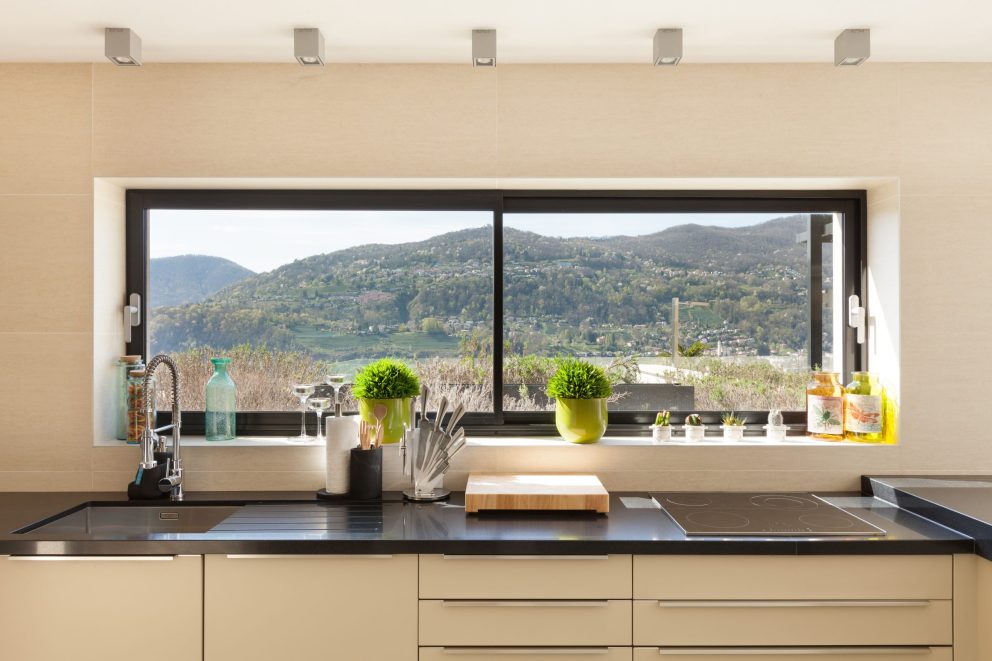
Where your window faces shapes both your light challenge and your privacy risk, making orientation the foundation of any treatment decision. North-facing kitchen windows bring in soft, diffuse daylight with minimal solar gain and limited street visibility, so sheer or unlined treatments work well while keeping Visible Light Transmittance (VLT) high. South-facing windows are the most demanding – full-day sun combined with direct street exposure calls for solar shades in 1%, 3%, or 5% openness ratings paired with a privacy lining. East and west-facing windows deal with low-angle morning and evening sun respectively, where top-down/bottom-up or motorized roller shades give you independent control over glare and sightlines.
| Window Orientation | Light Challenge | Privacy Challenge | Recommended Treatment |
|---|---|---|---|
| North | Low direct sun, diffuse daylight | Low street-level risk | Sheer or unlined treatment (high VLT) |
| South | High solar gain, full-day sun | High street visibility | Solar shades (1–5% openness) + privacy lining |
| East | Direct morning sun, low angle | Moderate neighbor sightlines | Top-down/bottom-up shades or motorized roller |
| West | Direct evening sun, low angle | Moderate to high street exposure | Top-down/bottom-up shades or motorized roller |
Treatment Layering for Independent Light and Privacy Adjustment
A two-layer system outperforms any single treatment by letting you control privacy and light quality independently. The primary layer – typically faux wood blinds or roller shades – handles sightline blocking at counter height, while a secondary layer of sheer café curtains or solar shades softens incoming daylight without covering the entire window. Because each layer operates on its own, you can pull back the diffusion layer for focused task lighting during food prep while keeping the privacy layer drawn toward street-facing sightlines.
VLT Spectrum: From Blackout to Sheer
Solar shades rated at 1%, 3%, and 5% openness factor represent the measurable spectrum between privacy and natural light in kitchen settings. At 1%, you get maximum privacy with very little light transmission – the right call for south-facing windows with direct street exposure. A 5% rating lets considerably more daylight through but offers less privacy protection, making it better suited to north-facing or elevated windows. Full blackout fabrics sit at the other extreme, achieving zero light transmission and complete privacy, though that total light elimination makes them a poor fit for task-driven kitchen environments.
How Low-E Glazing Enables Lighter Privacy Treatments
OKNOPLAST NFRC-certified triple-pane windows with Low-E coatings take on the solar heat management role that would otherwise fall to your treatment fabric on south and west-facing windows. With SHGC handled at the glazing level, solar shades on these orientations can deliver adequate privacy without needing heavy, room-darkening materials that cut out natural light. Top-down/bottom-up shades remain the ideal single-treatment solution here – raising the lower rail to counter height blocks direct sightlines while leaving the upper glazing area open, preserving the daylight your kitchen needs for comfortable, functional use.
Let’s talk about your project!
Request a quote, discuss specifications, or get help choosing the right system
Send a request
"*" indicates required fields