


Black Window Frames: Style, Durability, Cost, and Energy Performance

Key Takeaways:
- Black window frames carry a price premium of 10-25% over standard white frames – dual-color configurations (black exterior, white interior) sit at the higher end of that range, while single-color black exterior-only adds roughly 5-10%.
- Frame material determines how long the black finish lasts: aluminum with PVDF coating holds color for 25+ years; uPVC with RAL lamination film is rated 15-20 years; standard vinyl integral-color finishes in high-UV climates may show fading within 8-12 years.
- Black frames absorb up to 90% of solar radiation compared to approximately 15% for white frames, which raises surface temperatures by 20-40°C in direct sun – a relevant factor in Climate Zones 1-3 that affects thermal expansion tolerances and seal longevity.
Black window frames are a baseline specification choice in roughly 30% of new U.S. residential window projects as of 2024 – and the decision comes down to four factors: climate zone, frame material, finish technology, and cost. Whether the specification makes sense depends on how each factor interacts with a specific project, not on whether the style is currently trending. This guide addresses all four dimensions.
Are black window frames still in style – or have they become a permanent design standard?
Black window frames have transitioned from a design trend into a baseline specification choice – appearing in roughly 30% of new residential window specifications in the U.S. as of 2024, per Dodge Construction Network residential data, up from under 5% in 2015. The shift reflects a structural change in residential aesthetics, not a cyclical trend: black frames appeared on industrial steel windows over a century ago, were revived in European minimalist architecture in the 2000s, and entered mainstream U.S. residential construction through the farmhouse and modern-industrial boom of the mid-2010s. They have not retreated since.
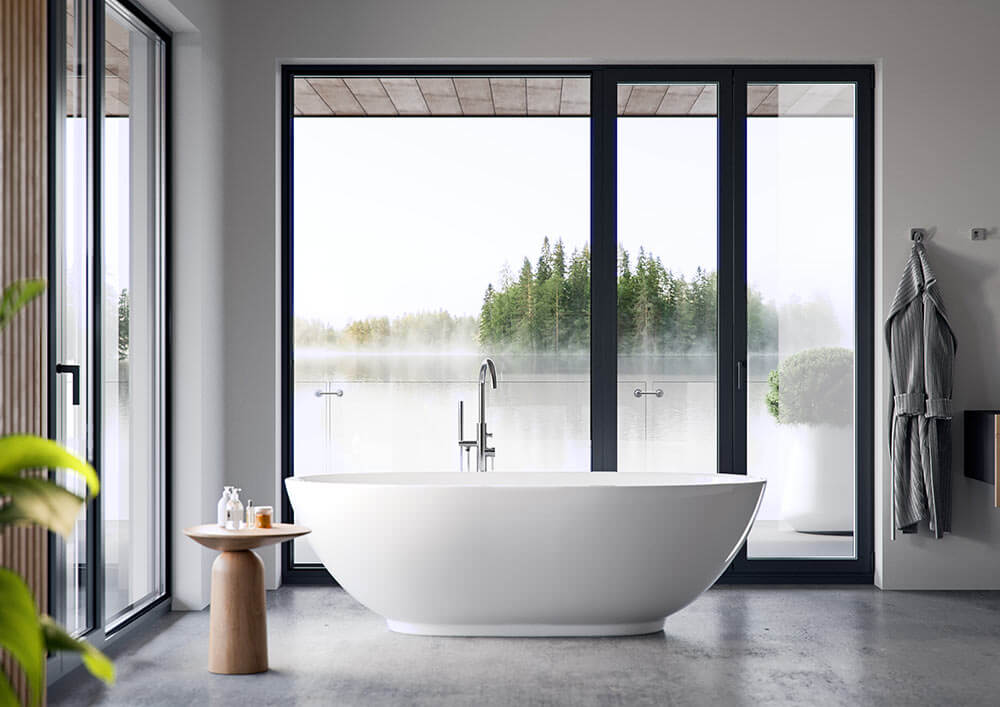
The longevity of this preference has a concrete explanation. Black is optically neutral against most exterior materials – red brick, white stucco, gray concrete, cedar siding – because its high reflectance contrast works with light-toned surfaces and its recessive quality works with dark-toned ones. Architect Dominic Bagnato, widely cited in design literature, describes it as a “forgiving colour” that functions like a classic black suit: nearly every adjacent color works with it. From the interior, the effect reverses: a black frame against a bright exterior sky creates a Simultaneous Contrast effect where the dark frame recedes visually, allowing the view to dominate the sash rather than the sash dominating the view.
The practical consequence for specification decisions: black window frames do not require coordinating the frame color with future interior or exterior repaints. A white frame becomes a liability when a homeowner repaints from white to gray – the frame either clashes or becomes invisible. A black frame remains compositionally stable across most exterior palettes, which is why architects and builders increasingly specify black as a default rather than a premium option.
How do black frames work across architectural styles: farmhouse, modern, industrial, and traditional?
Black window frames play 4 distinct structural roles across architectural styles – compositional anchor in modern, contrast element in farmhouse, historical reference in industrial loft, and period-appropriate detail in traditional. Each role calls for a different profile geometry: modern demands slim aluminum at 50-70mm; the other three contexts depend more on color relationship than profile depth.
Modern and contemporary
In modern construction, black frames serve as compositional anchors. A wall of floor-to-ceiling glazing without frame definition reads as undifferentiated glass; black frames at 50-70mm profile depth divide the surface into readable geometric units without adding decorative detail. This is the application where slim aluminum profiles – such as the MIRU EVO Hidden system with concealed hardware – are most effective: the frame is present enough to organize the facade but thin enough to maximize glass-to-frame ratio.
Modern farmhouse
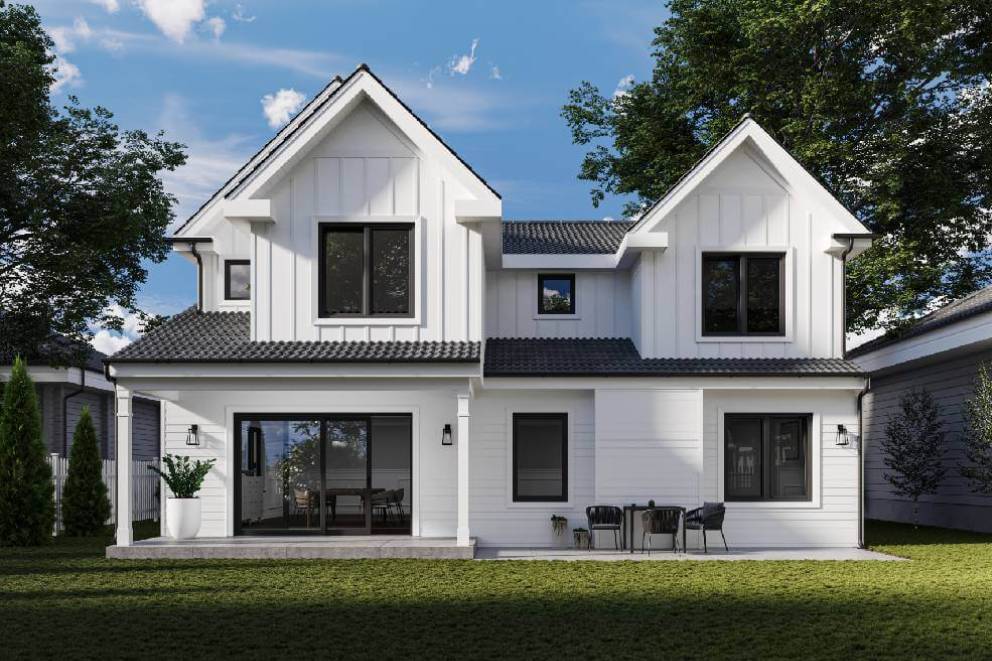
[H3_FARMHOUSE]Black frames in farmhouse applications function as contrast elements against white or light-colored board-and-batten or shiplap exteriors. The high contrast ratio – RAL 9005 black against RAL 9010 or 9016 white – creates the graphic quality that defines the style. Here, profile depth matters less than the color relationship: even a standard 82mm uPVC frame in matte black reads correctly against a white board-and-batten facade.
Industrial and loft
[H3_INDUSTRIAL]Industrial applications reference the original steel-framed warehouse and factory windows of the early 20th century. The MIRU EVO Steel system – aluminum that replicates the divided-light pattern of historic steel windows – is specifically suited to this context. The profile geometry, not just the color, needs to echo the thin steel members of the reference style. A standard casement in black does not read as industrial; a multi-lite steel-look frame in black does.
Traditional and transitional
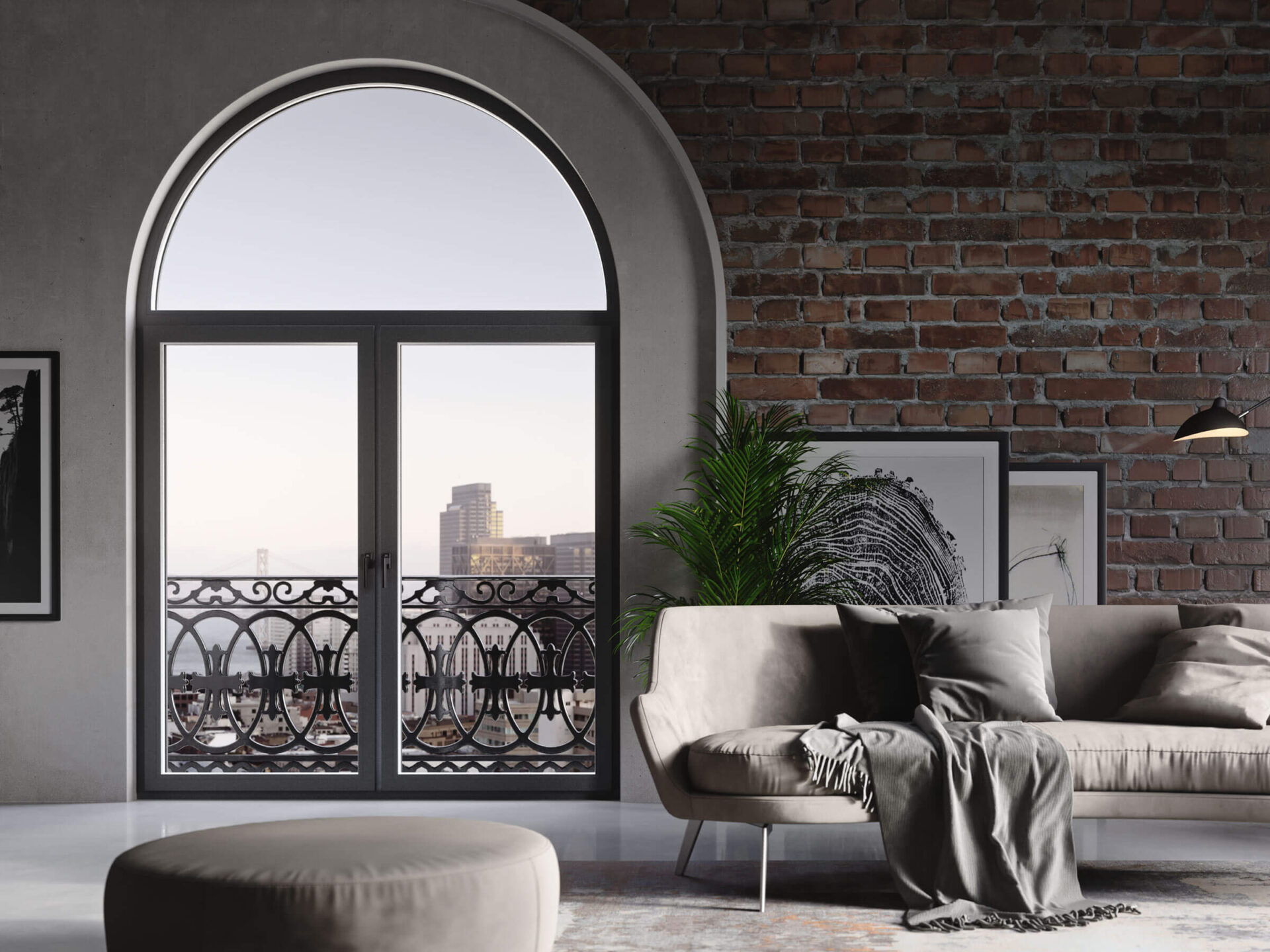
In traditional architecture – brick colonials, craftsman bungalows, historic revivals – black frames work because the color references historic painted steel windows that were standard in American residential construction through the mid-20th century. They complement red brick particularly well because the warm undertones of fired clay read against black without the visual competition that occurs with colored frames. In traditional homes, black frames pair well with exposed brick, natural wood furniture, and linen or neutral textiles. Black frames in these contexts look historically grounded, not industrial.

What material options are available for black window frames – and how do they compare?
Four materials are used for black window frames in the U.S. market – aluminum (profile depth 50-70mm), uPVC (typically 82mm), fiberglass, and wood-clad – and their black finish technologies range from 8-12 year budget vinyl to 25+ year PVDF-coated aluminum, making material selection the primary determinant of long-term color durability. The table below maps each material against the factors that matter for a black-finish specification.
| Material | Profile depth | Black finish | UV/fade life | Climate note | OKNOPLAST system |
|---|---|---|---|---|---|
| Aluminum (thermally broken) | ~50-70mm | Powder coat or PVDF | 25+ yrs (PVDF) | All zones; low thermal expansion | MIRU EVO Hidden, Standard, Steel |
| uPVC | 82mm (PAVA) | RAL coextrusion or lamination film | 15-20 yrs | Zones 4-8; avoid direct south-facing in Zone 1-3 without PVDF | PAVA, PIXEL |
| Fiberglass | Varies | Powder coat | 25+ yrs | All zones; minimal thermal expansion | Not in OKNOPLAST US line |
| Wood-clad | Varies | Aluminum exterior cladding (painted) | 20+ yrs | All zones; requires interior wood maintenance | Not in OKNOPLAST US line |
| Vinyl (standard) | Varies | Integral color or foil | 8-12 yrs (budget) | Zones 4-8 recommended; prone to fading in Zone 1-2 | Not in OKNOPLAST US line |
The OKNOPLAST U.S. line covers two of these four categories: thermally broken aluminum (MIRU EVO line) and uPVC (PAVA and PIXEL systems). Both are available in black finishes across their full size ranges. Aluminum profiles in the MIRU EVO Hidden configuration reach profile depths of approximately 60-70mm with concealed hardware, producing the narrowest sight lines in the MIRU EVO range. uPVC profiles in the PAVA system run at 82mm depth with 7-chamber construction and steel reinforcement in load-bearing chambers.
How does heat absorption affect black window frames – and which materials resist UV degradation?
Black surfaces absorb approximately 90% of incident solar radiation; white surfaces reflect approximately 85%. For window frames, this difference translates to surface temperature differentials of 20-40°C between black and white frames under direct summer sun in Climate Zones 1-3 (Southern U.S., Southwest). The thermal consequence is not energy loss through the glass – it is accelerated thermal expansion cycling in the frame itself, which affects the longevity of perimeter seals, weatherstripping compression, and the adhesion of any applied finish.
The susceptibility varies by material. Aluminum has a coefficient of thermal expansion of approximately 23 × 10⁻⁶/°C – meaning a 2-meter aluminum frame section will expand approximately 1mm for every 20°C of temperature change. In a black aluminum frame reaching 70°C surface temperature vs. a 20°C installation baseline, that is a 2.5mm differential that the frame-to-wall connection and weatherstripping must accommodate. uPVC has a higher coefficient of thermal expansion (approximately 70 × 10⁻⁶/°C), making it more sensitive to surface temperature changes – which is why uPVC black frames are typically not recommended for direct south-facing installations in Climate Zones 1-3 without high-specification UV-resistant coatings.
Finish technology and UV durability
The durability of the black color finish depends on the coating technology, not the frame material:
- Powder coat (polyester) on aluminum: electrostatic application, cured at 200°C. UV resistance rated 10-15 years in high-sun exposure. Standard specification for budget and mid-range aluminum systems.
- PVDF (polyvinylidene fluoride) / Kynar 500 on aluminum: 70% PVDF resin content. UV resistance rated 25+ years. Used in commercial curtainwall and premium residential aluminum. Resists chalking, color shift, and gloss loss under UV load. MIRU EVO systems can be specified with PVDF finish.
- RAL coextrusion on uPVC: black pigment fused into the outer skin of the uPVC profile during extrusion. No adhesion failure possible (color is the material). UV resistance 15-20 years. Standard for PAVA and PIXEL black configurations.
- RAL lamination film on uPVC: colored film applied post-extrusion. UV resistance 12-18 years depending on film grade. Used for dual-color configurations (black exterior / different interior).
For Climate Zones 1-3, specify aluminum with PVDF finish or uPVC with coextrusion (not lamination film) for south and west-facing facades. For Zones 4-8, standard powder coat or RAL coextrusion performs adequately for most residential applications.

What is the price premium for black window frames – and what drives the cost difference?
Black window frames carry a price premium of 10-25% over equivalent white frames, per industry pricing data across the U.S. residential fenestration market. The premium varies by configuration – single-color black exterior-only adds roughly 5-10%, while dual-color configurations (black exterior, white or other color interior) add 15-25%. The driver is not the color itself but the additional manufacturing steps required to apply and quality-control a dark finish.
| Configuration | Premium vs. white | Driver | Notes |
|---|---|---|---|
| Single color black (exterior only) | 5-10% | Standard powder coat or RAL film | Most common configuration |
| Single color black (full unit) | 10-15% | Full-unit coating vs. standard white base | Interior and exterior identical color |
| Dual-color: black exterior / white interior | 15-25% | Two-color coextrusion or secondary film application | Most specified in residential projects |
| Custom RAL beyond RAL 9005 | Add 5-10% | Non-standard color matching + batch minimum | Available across OKNOPLAST uPVC and aluminum |
For uPVC systems, the coextrusion process that fuses black pigment into the outer profile skin adds to material cost because black-pigmented compound requires a separate extrusion run from the standard white base. Lamination film for dual-color configurations adds a secondary process step at the profile mill. For aluminum systems, PVDF coating (the premium UV-resistant option) costs more than standard polyester powder coat because the resin content is higher and the cure process differs.
On a mid-size residential project replacing 15 windows at $800-$1,200 per unit in white, the 15-25% premium for dual-color black configurations adds $1,800-$4,500 to the total project cost. Against a $15,000-20,000 project baseline, this is a 10-20% cost increase for a finish decision that affects the long-term visual character of the building envelope. Most architects and builders working in the $1,000+ per-window segment treat it as a standard line item rather than a premium add-on.
Do black window frames qualify for ENERGY STAR certification and the §25C tax credit?
Frame color has no effect on ENERGY STAR certification or §25C Energy Efficient Home Improvement Credit eligibility – both are determined exclusively by NFRC-certified U-Factor and SHGC values, which are properties of the glazing system and frame geometry, not the frame color. A black PAVA window and a white PAVA window carry identical NFRC ratings when manufactured to the same specifications.
The §25C credit (IRS, tax year 2025) provides up to $600 per exterior window unit, with a $1,200 annual household cap, for NFRC-certified products meeting ENERGY STAR Most Efficient criteria. The credit applies to product cost only, not installation labor, and is claimed in the tax year the installation is completed. ENERGY STAR Most Efficient thresholds for 2025: Northern zone U-Factor ≤0.20, SHGC ≤0.40; North-Central U-Factor ≤0.22, SHGC ≤0.40.
| OKNOPLAST system | U-Factor range | ENERGY STAR zone(s) | Most Efficient eligible? | §25C credit up to |
|---|---|---|---|---|
| PAVA (uPVC, triple-pane) | 0.14-0.26 | All 4 zones (Northern ≤0.27) | Pending EPA approval – verify at purchase | $600/unit |
| PAVA Light (uPVC, double-pane) | 0.25-0.27 | Northern, N-Central | Verify per configuration | $600/unit |
| PAVA Impact (uPVC, HVHZ) | Zone 4 rated | Verify per glazing package | Verify per configuration | $600/unit |
| PIXEL (uPVC) | 0.16-0.29 | N-Central, S-Central, Southern | Partial – does not cover all zones at ME | $600/unit if NFRC-certified ME |
| MIRU EVO Hidden (aluminum) | Verify per data sheet | Verify per glazing package | Verify per configuration | $600/unit if NFRC-certified ME |
A black frame absorbs solar radiation that a white frame would reflect, adding marginally to total solar heat gain beyond what the NFRC SHGC label shows. The label reflects the glazing unit only, not the frame exterior color. In Climate Zones 1-3, specify SHGC 0.20-0.25 for south and west-facing black-frame installations to account for this difference – and note it when discussing NFRC documentation with the specifying architect.
What maintenance does black window frame ownership actually require?
Black window frames require exterior cleaning every 4-8 weeks in urban environments and every 6-10 weeks in suburban settings, compared to 3-6 months for white frames – a direct consequence of dust and water spots contrasting visibly against a dark matte surface.
Cleaning protocol for coated aluminum and uPVC black frames: warm water with mild pH-neutral detergent (no solvents, no abrasives), applied with a soft cloth or low-pressure rinse. Do not use steel wool, scrubbing pads, or solvent-based cleaners – these remove the surface coating and expose the base material. For PVDF-coated aluminum, periodic application of a non-abrasive automotive wax or dedicated aluminum frame polish extends the service life of the finish by filling micro-scratches that accumulate from cleaning cycles.
Dual-color configurations and interior maintenance
Dual-color windows – black exterior, white interior – address one of the most common maintenance objections to full black frames: the interior black surface shows handprints and cleaning residue near hardware and sill areas. With a white interior finish, the interior maintenance profile matches a standard white window. Only the exterior – which is cleaned from the outside and typically handled less frequently than interior surfaces – requires the higher cleaning frequency associated with black frames.
The OKNOPLAST uPVC systems (PAVA, PIXEL) are available in dual-color configurations with RAL 9005 or RAL 9004 exterior and white or off-white interior. Aluminum MIRU EVO systems can be specified with contrasting interior and exterior powder coat colors. Both configurations are produced at the factory; field-applied paint is not a substitute and voids the product guarantee.
See the products
Which OKNOPLAST systems deliver black frames – and what distinguishes each?
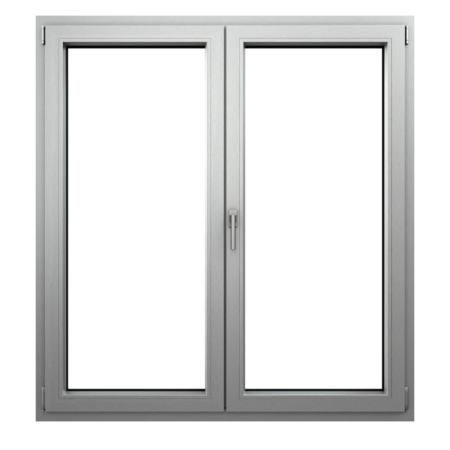
Three OKNOPLAST systems are available in black finishes in the U.S. market, covering two material categories: aluminum (MIRU EVO Hidden and MIRU EVO Steel, profile depth 60-70mm) and uPVC (PAVA at U-Factor 0.14-0.26, and PIXEL), each addressing a distinct project type and performance level.
MIRU EVO Hidden – aluminum, concealed hardware
uses concealed hinges and flush hardware to produce a completely uninterrupted sash face. In black, the visual result is a frameless-appearing opening: from the interior, the black sash recedes against the frame, and the hardware does not interrupt the plane. Architects specify it in contemporary residential, hospitality, and high-end renovation projects where the window should disappear into the wall plane rather than read as a distinct element. Supports large-format glazing and asymmetrical layouts. Profile depth approximately 60-70mm.
MIRU EVO Steel – aluminum, steel-look profile
https://oknoplast.us/windows/aluminum-windows/miru-evo-steelThe MIRU EVO Steel system uses a profile geometry that replicates the divided-light appearance of historic steel-framed factory and warehouse windows. In black, it is the correct specification for industrial, loft, and transitional-residential applications that reference 20th-century commercial architecture. The narrow sightlines and geometric divided-light pattern provide the visual reference that a standard casement in black does not. Available in tilt & turn operation.
PIXEL – uPVC, slim sash
The PIXEL system is the slim-sash uPVC option: the narrowest frame and sash profiles in the OKNOPLAST uPVC line. In black, it reads as a contemporary window with minimal frame presence, occupying a visual position between the warmth of uPVC and the slimness of aluminum. U-Factor range 0.16-0.29; meets ENERGY STAR requirements for North-Central, South-Central, and Southern zones. Note: PIXEL does not carry HVHZ certification. Available in RAL 9005 matte black.
PAVA – uPVC, thermal performance leader
PAVA is the OKNOPLAST system specified when thermal performance is the primary driver: 82mm profile depth, 7-chamber frame construction, triple glazing standard, U-Factor as low as 0.14. In black, it is specified where energy performance is the primary driver and the aesthetic requirement is for a black frame – typically Passive House or near-Passive House projects in Climate Zones 5-8, high-performance renovation in cold climates, and projects where §25C tax credit eligibility is a requirement. Available in RAL 9005 and RAL 9004 exterior with white or matching interior. PAVA Light (double-pane, U-Factor from 0.25) suits Zones 1-5 and wood-frame construction with tighter load limits. PAVA Impact serves HVHZ Zone 4 (Miami-Dade, Broward counties).
All three systems carry a 10-year product guarantee from OKNOPLAST USA. Installation by an authorized partner is required for PAVA and MIRU EVO lift & slide configurations to maintain warranty coverage. Lead time to U.S. delivery: 8-10 weeks from order confirmation.
FAQ
Yes. Black window frames carry a price premium of 10-25% over equivalent white frames. Single-color black exterior-only configurations add roughly 5-10%; dual-color configurations (black exterior, white interior) add 15-25%. The premium reflects additional manufacturing steps: a separate coextrusion run for black-pigmented uPVC profiles, or a higher-grade coating application for aluminum. On a 15-window residential project priced at $1,000 per unit in white, the dual-color black premium adds approximately $1,500-3,750.
Whether black frames fade depends on the finish technology, not the color itself. Aluminum frames with PVDF (Kynar 500) coating are rated for 25+ years of UV resistance with minimal color shift. uPVC frames with coextrusion black (pigment fused into the profile skin during extrusion) are rated 15-20 years. Standard polyester powder coat on aluminum is rated 10-15 years. Lamination film on uPVC is rated 12-18 years depending on film grade. Budget vinyl with integral black color is most susceptible to fading, particularly in Climate Zones 1-3. Always verify the finish specification, not just the color.
Yes. Black surfaces absorb approximately 90% of incident solar radiation vs. 15% for white, producing surface temperature differentials of 20-40°C under direct summer sun. This accelerates thermal expansion cycling in the frame and affects perimeter seal longevity – a relevant consideration for direct south and west-facing facades in Climate Zones 1-3. The effect is managed by specifying PVDF-coated aluminum or coextruded uPVC (not lamination film) for high-UV applications. The heat absorbed by the frame does not significantly affect whole-unit U-Factor or SHGC as rated by NFRC.
Pros: black frames are compositionally stable across exterior repaint cycles, recede from view on the interior to let the landscape dominate, and work across farmhouse, industrial, modern, and traditional styles without requiring coordination.
Cons: 10-25% higher purchase cost than white; higher cleaning frequency (4-8 weeks urban vs. 3-6 months for white); greater UV sensitivity on south and west-facing facades in Climate Zones 1-3, requiring PVDF or coextrusion finish specification rather than standard powder coat.
Yes, dual-color configurations are a standard factory option, not a custom order. OKNOPLAST uPVC systems (PAVA, PIXEL) are available with RAL 9005 or RAL 9004 exterior and white or off-white interior using lamination film or secondary coextrusion. MIRU EVO aluminum systems can be specified with contrasting interior and exterior powder coat colors. Dual-color configurations carry a 15-25% premium over single-color white and must be specified at order – field-applied paint is not a substitute and voids the product guarantee.
In Climate Zones 1-3 (Florida, Gulf Coast, Southwest), thermally broken aluminum with PVDF coating is the most durable specification for black frames on south and west-facing facades. PVDF resists UV degradation for 25+ years and tolerates higher surface temperatures without chalking or color shift. uPVC with coextrusion black (not lamination film) is acceptable for north and east-facing facades in these zones. Standard polyester powder coat on aluminum and lamination film on uPVC should be avoided for primary sun-exposure facades in Zone 1-3. In Zones 4-8, all finish options perform adequately for residential applications.
Clean with warm water and a pH-neutral detergent using a soft cloth or low-pressure rinse. Do not use solvents, acetone, abrasive pads, or steel wool – these damage the coating surface. For PVDF-coated aluminum, periodic application of a non-abrasive automotive wax or aluminum frame polish extends finish life by filling micro-scratches from cleaning cycles. Cleaning frequency: every 4-8 weeks in urban environments; every 6-10 weeks in suburban and rural settings. Dual-color frames (black exterior, white interior) require the higher cleaning frequency only on the exterior surface.
RAL 9005 (Jet Black) is a near-absolute black with minimal undertone – the standard specification for black window frames in contemporary and minimalist applications. RAL 9004 (Signal Black) has a very slight warm or neutral undertone and is marginally less intense; it is sometimes preferred in traditional and transitional applications where a pure black reads as too harsh against warm brick or stone. Both are available in OKNOPLAST uPVC and aluminum systems. The practical visual difference at normal viewing distance (3-5 meters) is minimal; the difference becomes perceptible in direct comparison at close range.

Let’s talk about your project!
Request a quote, discuss specifications, or get help choosing the right system
Send a request
"*" indicates required fields