


Tilt and Turn vs. Double-Hung, Casement & Sliding Windows


At first glance, tilt-and-turn windows, double-hung windows, casement windows, and sliding windows all do the same job-they let in natural light, fresh air, and views. The real difference is how they work. The way a window opens affects everything from ventilation and energy efficiency to cleaning, security, and everyday comfort. This guide compares tilt-and-turn vs. double-hung, casement, and sliding windows to help you choose the right window system for your project.
Key Takeaways:
- Tilt-and-turn windows combine two opening functions in a single sash, making everyday ventilation and cleaning easier.
- Double-hung, casement, and sliding windows each provide ventilation differently, so the best choice depends on your home’s needs.
- Multi-point locking helps tilt-and-turn windows create a tighter seal than many traditional American window styles.
- Window design affects much more than appearance-it also influences comfort, maintenance, energy efficiency, and security.

What are tilt-and-turn windows and how do they work?
Tilt-and-turn windows combine two opening functions in a single sash. With one handle, homeowners can choose secure everyday ventilation or open the window fully inward for maximum ventilation and easy cleaning. Unlike most traditional American window styles, they also use a European multi-point locking system that helps create a tighter, more energy-efficient seal.
For decades, tilt-and-turn windows have been the standard in many European homes. Originally developed in post-war Germany, they combine two opening functions in a single sash and solved a common challenge: providing effective ventilation without sacrificing airtightness in densely built residential buildings. Today, Oknoplast.us brings this proven European window technology to the U.S. market with custom-sized uPVC windows designed for American homes.
Operating the window is simple. With the handle in the closed position, the sash locks securely around its entire perimeter using a European multi-point espagnolette locking system. Turn the handle 90 degrees to tilt the top of the sash inward, typically creating about a 3–4-inch opening for secure everyday ventilation while the bottom remains locked. Rotate it another 90 degrees, and the sash swings fully inward, providing maximum ventilation while allowing both sides of the glass to be cleaned safely from inside the home.
What are the mechanism and design differences between European tilt-and-turn windows and American double-hung, casement & sliding windows?
The biggest difference between European tilt-and-turn windows and traditional American window styles is the way they work. Instead of relying on separate window styles for ventilation and full opening, this European window technology combines both functions in a single sash. That affects not only how the window opens, but also how it seals, locks, performs, and even looks.
Once you compare how each window operates, the design differences become much easier to understand. Traditional American windows were each designed around a single opening method, while tilt-and-turn windows combine multiple opening modes within a single sash.
- Double-hung windows have two vertically sliding sashes. Many modern models include tilt-in sashes for easier cleaning, but they don’t combine secure tilt ventilation and full inward opening in the same way as tilt-and-turn windows.
- Casement windows are hinged on one side and open outward with a crank. They provide excellent ventilation but offer only one opening position.
- Sliding windows move horizontally along a track. They’re easy to operate, although ventilation is limited to the portion of the opening left uncovered by the moving sash.
The opening system also influences the overall design. Tilt-and-turn windows typically have slimmer sightlines and larger glass areas, while traditional double-hung windows include a horizontal meeting rail where the sashes overlap. Casement and sliding windows create their own visual proportions based on how the sash operates.
| Feature | Tilt-and-Turn Windows | Double-Hung Windows | Casement Windows | Sliding Windows |
| Opening method | One handle controls tilt ventilation and full inward opening | Two vertically sliding sashes | Side-hinged sash opens outward with a crank | Horizontally sliding sash |
| Ventilation | Secure tilt ventilation or full opening | Sliding ventilation | Full outward opening | Partial opening |
| Cleaning | Both sides of the glass can be cleaned from indoors | Many modern models include tilt-in sashes for easier cleaning | Exterior glass may require outdoor access, depending on installation | Exterior glass may require outdoor access, depending on installation |
| Locking integration | Multi-point locking integrated into one handle | Typically single-point sash lock | Typically single-point locking hardware | Typically single-point latch |
How do uPVC European window frames with multi-chamber thermal breaks compare to American vinyl frames in durability and insulation?
Both European uPVC and American vinyl frames are made from PVC resin but use different frame construction methods. While both are PVC windows, Oknoplast.us European frames typically feature 5–7 internal chambers with galvanized steel reinforcement, while standard American residential vinyl frames generally use 2–3 chambers without steel reinforcement. These differences in frame construction affect insulation, durability, and overall thermal performance.
How does frame construction differ?
Although both systems use PVC resin, European uPVC profiles typically feature 5–7 internal chambers, thicker walls, and galvanized steel reinforcement, while standard American residential vinyl frames generally use 2–3 chambers and different structural designs.
In both systems, the internal chambers trap still air. However, a higher number of chambers creates more thermal breaks, helping reduce heat transfer through the frame. This lowers the frame’s contribution to the whole-window U-factor, improving thermal performance and insulation.
How does structural support differ?
European tilt-and-turn windows use multi-point locking hardware that places greater structural demands on the frame. As a result, European uPVC profiles typically incorporate galvanized steel reinforcement, which improves rigidity without creating a significant thermal bridge, while standard American residential vinyl frames generally do not because they are designed around different window styles and hardware systems.
How do these design choices affect long-term performance?
Over time, these design differences influence how well a frame maintains its shape and sealing performance. Steel reinforcement helps European uPVC frames resist racking-the gradual diagonal deformation that can affect larger operable sashes over a 20–30 year service life-while helping maintain gasket compression and consistent sealing performance.
Manufacturing precision also plays an important role. Oknoplast.us profiles are produced with precise extrusion tolerances that maintain consistent gasket groove geometry, helping compression seals perform reliably through repeated expansion and contraction cycles.
Both European and American PVC formulations include UV stabilizers. Some European profile manufacturers, such as OKNOPLAST, also use higher titanium dioxide content to improve long-term color stability.
| Frame Property | Oknoplast.us European uPVC | Standard American Vinyl |
| Internal Chambers | 5–7 internal chambers | Typically 2–3 internal chambers |
| Steel Reinforcement | Galvanized steel reinforcement inserts | Typically no steel reinforcement in residential frames |
| Racking Resistance | Steel reinforcement helps maintain frame geometry over a 20–30 year service life | Larger unreinforced sashes may be more susceptible to racking over time |
| Frame U-Factor Contribution | Multi-chamber frame construction helps reduce the frame’s contribution to the whole-window U-factor | Frame contribution varies depending on profile design and chamber configuration |

How compression gaskets vs. traditional weatherstripping influence air infiltration and airtightness
Oknoplast.us tilt-and-turn windows use continuous EPDM compression gaskets drawn uniformly against the sash by multi-point locking hardware, achieving NFRC Air Leakage rates as low as 0.10 cfm/ft²-well below the residential threshold of 0.30 cfm/ft². By comparison, American double-hung windows typically rely on pile weatherstripping, typically achieving 0.20–0.30 cfm/ft² when new and may lose effectiveness as the material compresses over time.
How do compression gaskets create a tighter seal?
Unlike brush or foam weatherstripping, EPDM compression gaskets form a continuous seal around the entire sash perimeter. When the window is closed, the multi-point locking system draws the sash evenly against the gasket at multiple contact points, applying consistent pressure instead of relying on sash weight or spring tension alone. This creates a more uniform barrier against air infiltration while helping maintain thermal performance throughout the window’s service life.
Tilt-and-turn windows also maintain weather resistance while ventilating. In the tilt position, the gasket remains partially engaged, allowing fresh air to enter through the top opening rather than gaps around the frame.
How does traditional weatherstripping compare?
Many American double-hung windows use pile weatherstripping or foam tape placed only where the sash contacts the frame. While effective when new, the fibers or foam gradually compress with repeated use, potentially increasing air infiltration after 5–10 years.
Lower air leakage also supports demanding performance standards. Continuous compression gaskets are widely used in Passive House projects because they help achieve the required level of airtightness. EPDM gaskets are rated for a 30+ year service life under normal thermal cycling and can be replaced without removing the frame, simplifying long-term maintenance.
| Seal Type | Mechanism | Typical NFRC Air Leakage | Typical Service Life |
| EPDM Compression Gasket | Continuous perimeter gasket compressed by multi-point locking hardware | As low as 0.10 cfm/ft² | 30+ years |
| Pile Weatherstripping | Brush or foam compressed by sash movement or spring tension | Typically 0.20–0.30 cfm/ft² when new | 5–10 years before noticeable performance degradation |
How multi-point locking systems enhance forced-entry resistance compared to single-lock American windows
Multi-point locking is one of the defining features of European window security. Oknoplast.us multi-point espagnolette locking engages 4–6 contact points around the sash perimeter with a single handle rotation, distributing forced-entry resistance across the entire frame. By comparison, most American double-hung, casement, and sliding windows rely on a single locking point, concentrating resistance at one location that is more vulnerable to prying attacks.
How does multi-point locking work?
Unlike traditional single-latch systems, a multi-point espagnolette mechanism secures the sash at multiple locations simultaneously. As the handle rotates, locking bolts, hooks, or mushroom cams engage around the top, bottom, and sides of the frame, pulling the sash evenly into its closed position.
This distribution of locking points changes how force is applied during an attempted break-in. Instead of overcoming a single latch, an intruder must defeat multiple locking points simultaneously, making pry attacks more difficult with common hand tools. Because the hardware is built into the profile during manufacturing, the window retains clean sightlines without additional surface-mounted locks.
How does it compare with traditional American window locks?
Most American residential windows use a single locking point near the center of the sash. While adequate for everyday operation, this design concentrates resistance in one location, allowing leverage applied at a corner or along the sash perimeter to place greater stress on the lock.
The locking hardware works together with the window frame. Oknoplast.us steel-reinforced uPVC profiles help resist frame deformation under pry loads, allowing the locking points to remain properly aligned even when force is applied. Many residential American vinyl frames are not reinforced with steel because they are engineered around different window styles and hardware systems.
European multi-point systems can also meet DIN EN 1627 RC2, which requires at least three minutes of resistance to manual attack tools under standardized testing. Because tilt-and-turn windows open inward, the glazing cannot simply be pushed into the room from outside-forced entry through the glass requires breaking it rather than pushing the sash inward.
| Security Feature | Oknoplast.us Multi-Point | American Single-Point |
| Locking Contact Points | 4–6 locking points engage simultaneously around the sash | Single central latch |
| Pry Resistance Distribution | Force is distributed across the full sash perimeter | Resistance is concentrated at one locking point |
| Frame Deformation Resistance | Steel-reinforced uPVC frame helps maintain lock alignment under load | Performance depends on frame construction; most residential vinyl frames are not steel reinforced |
| Glazing Attack Vector | Inward-opening sash prevents push-in attacks through intact glazing | Security depends on window style and locking configuration |
What are the typical upfront and lifecycle cost differences between European triple-glazed uPVC windows and American double-pane vinyl windows?
Oknoplast.us European triple-glazed uPVC windows typically cost $800–$1,800+ per unit, representing a 40–80% premium over American double-pane vinyl replacement windows, which generally range from $450–$900. While upfront window costs are higher, cost comparison over the full lifecycle often favors European systems thanks to a 30+ year service life, replaceable EPDM gaskets, and potential annual energy savings that can offset the initial premium over time.
What drives the initial price difference?
Several factors contribute to the higher window cost of European systems. Each Oknoplast.us window is custom manufactured with triple glazing, steel-reinforced multi-chamber uPVC profiles, and European multi-point hardware. Final pricing also depends on window size and glazing specifications.
Installation costs are typically higher because Oknoplast.us windows use structural frame attachment with foam-and-tape airtight sealing instead of a traditional nailing fin, requiring more skilled labor.
How do lifecycle costs compare?
Upfront price tells only part of the story. Oknoplast.us systems are designed for a 30+ year service life, while standard American vinyl windows typically last 15–20 years. Replaceable EPDM compression gaskets and steel-reinforced frames help maintain long-term performance without full frame replacement.
According to the U.S. Department of Energy, replacing older windows with energy-efficient replacement windows can reduce annual heating and cooling costs by $101–$583, depending on climate zone and replacement scenario. Triple-glazed systems meeting a Northern climate zone U-factor of 0.27 or lower deliver the greatest heating-season savings in colder regions.
For contractors working on high-end homes, European window installations often represent higher-value projects. Whole-house replacements commonly range from $15,000 to $50,000+, creating greater project profitability than high-volume replacement work.
| Cost Category | Oknoplast.us European uPVC | American Double-Pane Vinyl |
| Product Cost Per Unit | Typically $800–$1,800+ | Typically $450–$900 |
| Installation Method | Precision frame attachment with foam-and-tape airtight sealing | Traditional nailing-fin installation |
| Expected Service Life | 30+ years | Typically 15–20 years |
| Potential Annual Energy Savings | U.S. DOE estimate: $101–$583, depending on climate and replacement scenario | Savings depend on window specification and replacement scenario |

Customization and made-to-measure sizing: European bespoke options vs. standard American window sizes
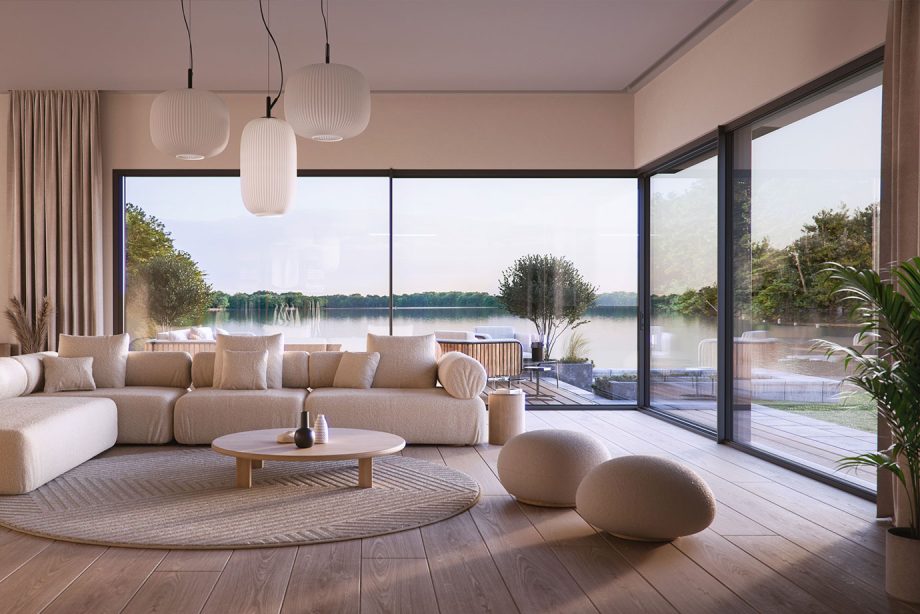
Oknoplast.us manufactures every window to millimeter-precise project dimensions instead of using a standard size grid. This custom sizing gives architects greater design flexibility for floor-to-ceiling glazing, intermediate frames, and other architect-designed openings without compromising aesthetics or adapting designs to standard window sizes.
How does made-to-measure manufacturing work?
Unlike many American windows, which are manufactured within standard size grids, European windows from Oknoplast.us are built only after final site measurements are confirmed. Each unit is manufactured with millimeter-level precision to fit the opening exactly, rather than selecting the closest standard size.
This approach gives architects greater design flexibility while helping improve installation quality. It can:
- minimize filler strips,
- reduce field modifications,
- maintain consistent sealing and installation quality,
- support floor-to-ceiling glazing,
- accommodate panoramic windows,
- simplify intermediate frames,
- enable architect-designed openings.
Without the limitations of standard size charts, architects have more design options to specify oversized glazing, corner configurations, and other custom openings.
What are the benefits of made-to-measure sizing?
Many American manufacturers build windows in common residential sizes, although custom units are also available. Standard dimensions typically reduce production time and manufacturing costs for replacement projects.
Oknoplast.us extends customization beyond size by offering:
- factory-applied exterior finishes, including white, anthracite gray, and golden oak woodgrain,
- multiple glass packages,
- hardware finishes,
- accessories.
Factory-applied finishes require no repainting throughout their 30+ year service life. For architects designing high-end homes, this flexibility makes it easier to match window specifications to the architectural vision instead of adapting designs to available stock sizes.
| Customization Dimension | Oknoplast.us European uPVC | American Vinyl Standard |
| Sizing | Built to millimeter-precise project dimensions | Many models offered in standard residential sizes |
| Color Finish | Multiple factory-applied finishes, including white, anthracite gray, and golden oak | Options vary by manufacturer and product line |
| Glass Options | Wide selection of glazing packages | Options vary by manufacturer and product line |
| Lead Time | Produced after final project measurements are confirmed | Standard sizes are often available faster |
FAQ
Often yes. Their design helps reduce air infiltration and improve thermal performance.
No. Routine maintenance is similar to other premium windows, and replacement parts are available through Oknoplast.us.
They are typically custom-made and include premium features such as triple glazing and multi-point locking systems.
It depends on your priorities, budget, climate, and the level of energy efficiency and customization you want.
Yes. Common replacement parts are stocked through Oknoplast.us’s U.S. support network, while specialized components may require additional delivery time.
Yes, custom sizing allows tilt-and-turn windows to fit many existing window openings.
Yes, multi-chamber uPVC frames, compression gaskets, and advanced glazing help reduce heat loss, making tilt-and-turn windows well suited for cold climates.



Let’s talk about your project!
Request a quote, discuss specifications, or get help choosing the right system
Send a request
"*" indicates required fields