


Why Professionals Choose OKNOPLAST Tilt and Turn Windows?


Window selection shapes buildability, inspection outcomes, and a building’s performance over time. Contractors and architects need predictable lead times, tested performance, clean integration with U.S. wall assemblies, and support that holds up when schedules tighten.
That’s why OKNOPLAST’s Tilt and Turn windows are specified for that kind of work. Learn more!
- What makes Tilt and Turn windows ideal for modern U.S. construction?
- Why professionals choose OKNOPLAST — execution and support
- Jobsite-ready performance and detailing
- Certified performance and code compliance across U.S. climate zones
- FAQ
Key Takeaways:
- Tilt and Turn windows combine secure ventilation, easy cleaning, and strong energy performance in one system.
- Inward-opening operation simplifies façade design and supports ADA-friendly usability.
- Verified NFRC and NAFS ratings ensure code compliance across U.S. climate zones, including HVHZ and Passive House projects.
- Jobsite-friendly detailing—like nailing fins, brickmould, and multi-point locking—helps streamline installation and inspections.
- Case studies show why builders and architects value predictable logistics, submittals, and responsive technical support.
What makes Tilt and Turn windows ideal for modern U.S. construction?
Tilt and Turn windows have two operating modes from a single handle: tilt (top of the sash leans in for secure ventilation) and turn (the sash swings inward for full opening).
Why that matters on real projects?
- Airflow & comfort: controlled ventilation without cracking a window outward into walkways; night-tilt helps purge heat while maintaining security.
- Maintenance & safety: inward swing allows cleaning and service from inside—useful above grade and on tight sites.
- Security & sealing: multi-point locking and continuous compression gaskets create a tight close; tilt mode keeps the sash latched while venting.
- Energy performance: the compression seal around the sash helps limit air leakage compared with sliding balances or meeting rails in many legacy window types (assuming proper spec and installation).
- Usability: one handle governs both actions; accessible hardware options support ADA-friendly operation inside the home.
Design adaptability
Architects use Tilt and Turn to keep façades clean (no exterior screens or protruding sashes), to coordinate with large fixed lites for ribbon windows, and to align with modern interiors where inward operation is preferred. Frames accept a wide range of glazing builds—thermal, solar-control, and acoustic—so the same platform can serve bedrooms, living areas, and street-facing rooms with higher noise exposure.
Why professionals choose OKNOPLAST — execution and support
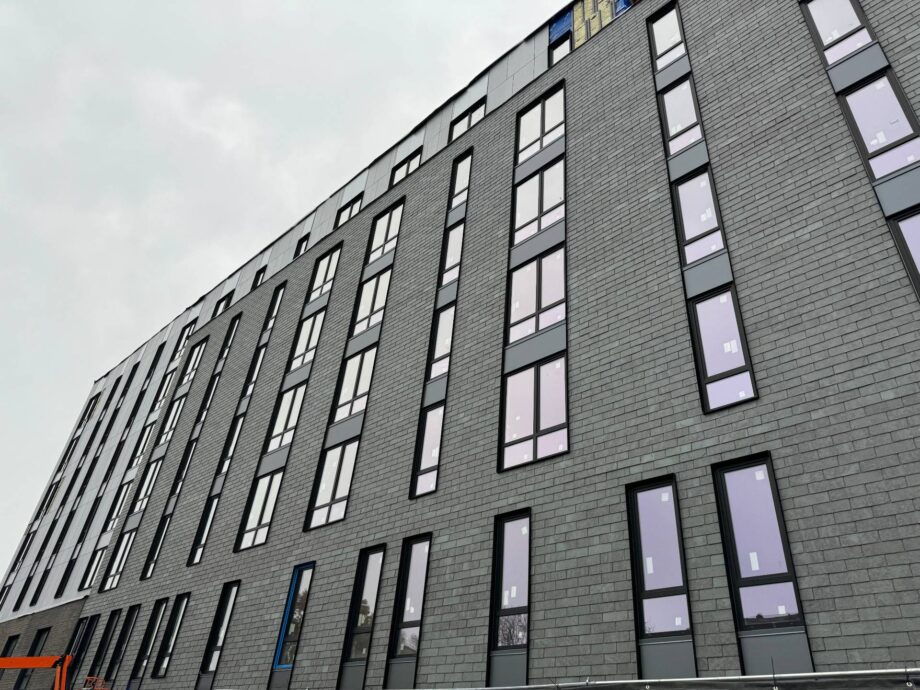
But let’s think about big projects for a moment. When a new building emerges in the center of a city, teams need predictable partners on high-stakes jobs like that. OKNOPLAST delivers submittals that match the drawings, coordinates logistics, and provides responsive technical support when field conditions change. Our dealer–installer network helps align shop drawings, delivery windows, and on-site adjustments so crews stay on schedule. But to show you a real project, we’d like to point you to one of our most recent projects.
Preconstruction put OKNOPLAST and Laurel Windows on the job with one mandate: hit the schedule and keep the envelope clean. Submittals moved fast, and when design decisions were pushed late, the team still delivered the first sequence in six weeks—packed and staged by elevation and floor so crews could install it in order. Technicians flew in to train the installers, and support stayed on site as work ramped up.
Superintendent Caitlyn Fitzgerald notes that the windows “stood the test of the construction process”—no sticking, smooth operation as the building settled, and a finish that “cleans up really well.” What stood out was the partnership: Martina drove approvals proactively; Cody Pelletier, an installer by trade, caught issues early at unloading, adjusted methods with the crew, and kept responses same-day. The result was a window package the GC was proud to tour—a dual-function Tilt and Turn that worked in the field and passed review—earning referrals to future projects.
“We needed eight weeks; they delivered in six … zero issues with the windows functioning properly—and it’s a product we want to show off.”



Jobsite-ready performance and detailing
Performance only counts if crews can set the windows without workarounds. OKNOPLAST Tilt and Turn windows are steel-reinforced with multi-point locking, and you can order them with a perimeter nailing fin or brickmould so WRB tape and flashing go on the way your team already builds. The compression gasket gives a tight close, and tilt mode vents the room without blowing the seal.
The numbers line up on paper and on site. You get NFRC/NAFS test data for submittals, and the units are tested for thermal, structural, air, and water performance across U.S. conditions. In practice, they tie into typical wall sections cleanly and pass inspection without drama.
Certified performance and code compliance across U.S. climate zones
On U.S. jobs, windows are judged by verified ratings, not anecdotes. Every OKNOPLAST unit comes with NFRC data U-factor (insulation), SHGC (solar gain), VT (visible light), and Air Leakage so architects and inspectors can confirm energy-code paths quickly. Structural and water performance are documented through NAFS/DP (or PG) and water-penetration testing, and impact options are available where HVHZ/Florida approvals apply. For high-performance work, OKNOPLAST systems can meet Passive House–level targets when specified with the right glazing and details.
If you’re planning a high-performance build, start here: learn about OKNOPLAST’s certified window systems. We also invite you to explore completed projects using Tilt and Turn windows.
OKNOPLAST windows must meet IBC and IRC requirements, including bedroom egress standards, energy codes (U-factor/SHGC), and structural tests (AAMA/WDMA/CSA). In hurricane zones, HVHZ certification may apply. Proper installation methods ensure compliance.
They include multi-point locking systems, reinforced steel frames, burglar-resistant glass, lockable handles, and premium anti-lift hardware. Many models also meet RC2/RC3 security certifications.
OKNOPLAST smart controls allow remote operation of windows, blinds, and sensors, and can be automated based on routines or weather. They integrate with Alexa and Siri, and connect with alarms or HVAC systems for a full smart home experience.


Let’s talk about your project!
Request a quote, discuss specifications, or get help choosing the right system
Send a request
"*" indicates required fields